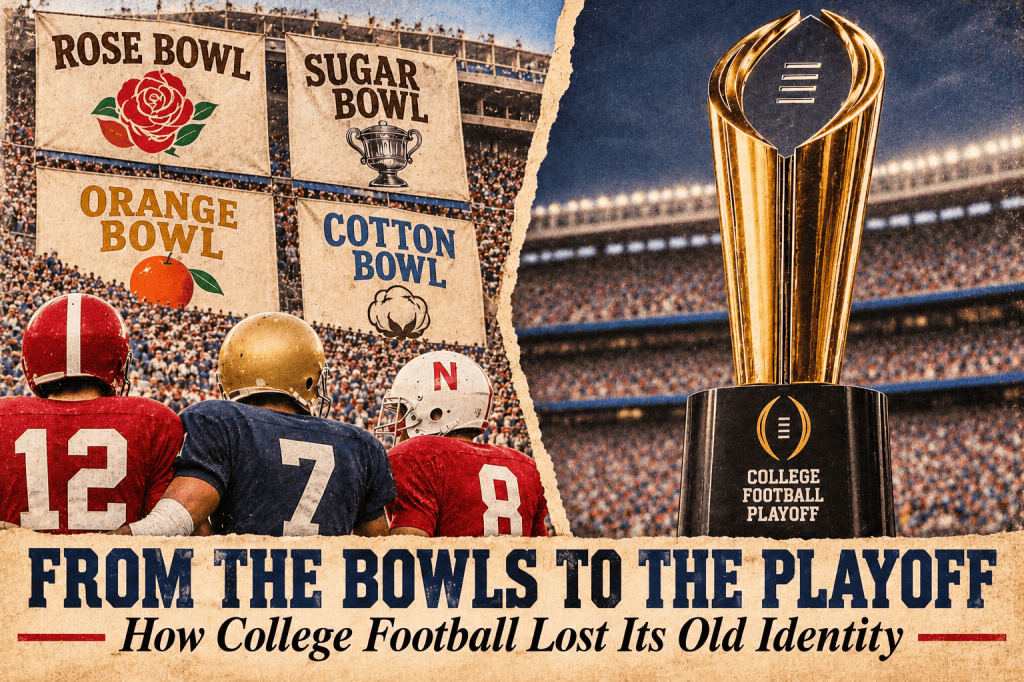
I remember when the road to a national championship ran through Pasadena, New Orleans, Miami and the Orange Bowl. Now it runs through a selection committee, a bracket, and a whole lot less meaningful regular season games.
There was something magical about New Year’s Day in college football.
You woke up, turned on the television, and settled in for an entire day of football. The Rose Bowl. The Sugar Bowl. The Orange Bowl. The Cotton Bowl. Each game had its own personality, its own traditions and, in many cases, its own conference affiliations.
Winning a bowl game meant something. It was the reward for a season’s worth of hard work, and for many programs, simply getting an invitation was a tremendous accomplishment.
But somewhere along the way, college football decided that wasn’t quite good enough.
The sport wanted a definitive national champion. Then it wanted a playoff. Then it wanted a bigger playoff. And now, with a 24-team expansion on the horizon, the postseason is beginning to look like something nobody could have imagined when the Rose Bowl was the unquestioned centerpiece of New Year’s Day.
So how did we get here?
And perhaps more importantly, what have we lost along the way?
When the Bowls Were the Destination
For generations, college football’s postseason revolved around the major bowl games.
The Rose Bowl was the Granddaddy of Them All, traditionally featuring the Big Ten and Pac-10 champions. The SEC had its relationship with the Sugar Bowl. The Big Eight was closely tied to the Orange Bowl, while the Cotton Bowl was a showcase for the Southwest Conference.
These weren’t just football games. They were traditions.
A trip to Pasadena was a reward. A Sugar Bowl appearance was something a program could celebrate for years. Coaches built seasons around the opportunity to reach one of these destinations.
There was one rather significant problem, however.
The national championship was determined by polls, not an actual championship game.
That meant the season could end with two different teams claiming national championships. In fact, it happened several times.
In 1990, Colorado and Georgia Tech shared the national championship. In 1991, Miami and Washington both finished atop different polls.
And in 1997, Michigan and Nebraska split the national title after Michigan won the Rose Bowl and Nebraska defeated Tennessee in the Orange Bowl.
Imagine that happening today.
The sport desperately wanted a way to settle the argument on the field.
The BCS Arrives: Computers, Polls and Plenty of Arguments
The early 1990s brought the Bowl Coalition and then the Bowl Alliance, both attempts to get the nation’s best teams into the same postseason games.
Finally, in 1998, the Bowl Championship Series arrived.
The concept was relatively simple: combine human polls and computer rankings to determine the two highest-ranked teams, then put them together in a national championship game.
For the first time, college football had a system designed to produce one undisputed champion.
It also gave us some unforgettable moments.
Tennessee defeated Florida State in the inaugural BCS championship game following the 1998 season. Oklahoma, Miami, Ohio State, USC, Texas and Florida all enjoyed championship moments during the BCS era.
But the computers couldn’t keep everybody happy.
The 2003 season was a particularly messy example. LSU defeated Oklahoma in the BCS championship game, while USC finished No. 1 in the Associated Press poll and claimed a national championship of its own.
Then came the 2004 season, when Auburn finished undefeated but was left out of the championship game.
The BCS was supposed to eliminate controversy. Instead, it became one of the biggest sources of it.
Still, there was something about those BCS championship games. The anticipation, the arguments over the rankings, and the feeling that two teams had finally reached the ultimate destination.
College football was getting closer to a true postseason tournament.
The Four-Team Playoff Changes Everything
In 2014, the BCS officially gave way to the College Football Playoff.
The new format selected four teams and matched them in two semifinal games, with the winners advancing to the national championship.
It was a major change.
The selection committee replaced the complicated BCS formula, and for the first time, teams could win a national championship by surviving an actual playoff bracket.
The inaugural playoff delivered one of the most memorable championship runs in modern college football.
Ohio State entered as the fourth seed, defeated Alabama in the Sugar Bowl semifinal and then beat Oregon in the championship game.
The four-team format gave us plenty of memorable moments over the next decade.
Clemson and Alabama became familiar postseason opponents. Georgia established itself as a national powerhouse. LSU’s 2019 team delivered one of the greatest seasons in college football history.
But the four-team playoff had its own problem.
Four spots simply weren’t enough.
Every season brought arguments about the teams left out. Undefeated Group of Five programs struggled to earn consideration. Conference champions were sometimes left watching from home.
In 2017, UCF finished undefeated and claimed a national championship despite not receiving a playoff invitation.
In 2023, Florida State finished the regular season undefeated in the ACC and was left out of the four-team field.
The playoff had solved one problem while creating another.
Twelve Teams: Everybody Gets a Seat at the Table
Beginning with the 2024 season, college football expanded the playoff to 12 teams.
The format brought something entirely new to the sport: first-round playoff games played on campus.
Suddenly, college football fans could experience postseason games in some of the sport’s most iconic stadiums.
The first expanded playoff produced an unexpected champion.
Ohio State entered the postseason as the No. 8 seed, defeated Tennessee, Oregon and Texas, and then beat Notre Dame in the national championship game.
The following season, Indiana completed an undefeated championship run, defeating Miami in the 2026 national championship game.
The expanded format created more opportunities, more meaningful December games and a much larger postseason spectacle.
But it also changed the stakes of the regular season.
A loss that once might have ended a team’s championship hopes could now be overcome. Conference championship games became part of a much larger postseason equation. The selection committee became an even bigger part of the weekly college football conversation.
And the bowl games?
They were increasingly becoming stages within a larger tournament rather than the destination themselves.
And Now We’re Heading to 24 Teams
If you thought 12 teams was a big change, college football isn’t finished.
A 24-team playoff is scheduled to begin with the 2027-28 season.
That means even more programs will have a shot at a national championship, and the postseason will become an even larger event.
The top eight seeds will receive first-round byes, while teams seeded ninth through 24th will compete in opening-round games hosted on campus.
Think about that for a second.
A sport that spent generations debating whether two teams deserved a chance to play for a championship will soon have 24 teams competing for one.
It’s a remarkable transformation.
And it raises an interesting question: At what point does the regular season begin to lose some of its uniqueness?
College football was always different from professional football. Every Saturday mattered because the margin for error was so small. Rivalries carried enormous weight. A November loss could change the entire trajectory of a season.
That’s what made the sport so compelling.
What Did We Really Lose?
Here’s the thing: I’m not suggesting that the old system was perfect.
It wasn’t.
Auburn deserved a shot in 2004. UCF deserved more consideration in 2017. Florida State’s exclusion in 2023 demonstrated the limitations of the four-team system.
There were legitimate reasons to expand.
And there’s no denying that playoff football has delivered some tremendous entertainment.
But there’s also something worth remembering about the old bowl system.
The Rose Bowl wasn’t just a game. It was an event. The Sugar Bowl wasn’t simply a quarterfinal location. It was a destination with decades of history behind it.
New Year’s Day used to feel like a national holiday for college football fans.
You could spend the entire day watching teams that had earned their way into the postseason, even if they weren’t competing for a national championship.
There was room for a great Michigan-Florida game, an Oklahoma-Arkansas matchup or a classic Rose Bowl between the Big Ten and Pac-10.
The bowls had identities. They had traditions. They had meaning beyond the final rankings.
Today, everything seems to revolve around the championship bracket.
Perhaps that’s progress. Perhaps it’s simply the evolution of a sport that has become bigger, wealthier and more complicated than anyone could have imagined.
But somewhere between the BCS computers and the coming 24-team playoff, college football became a very different animal.
And for those of us who remember the old New Year’s Day lineup, it’s hard not to miss a little bit of what made it special.
The games are bigger. The stakes are higher. The playoff is expanding.
But sometimes, the best part of college football wasn’t figuring out who deserved to be No. 1.
It was waking up on New Year’s Day, grabbing something to eat and knowing there were still eight hours of bowl games waiting for you.
That was college football.
And there will never be another New Year’s Day quite like it.


Leave a Reply