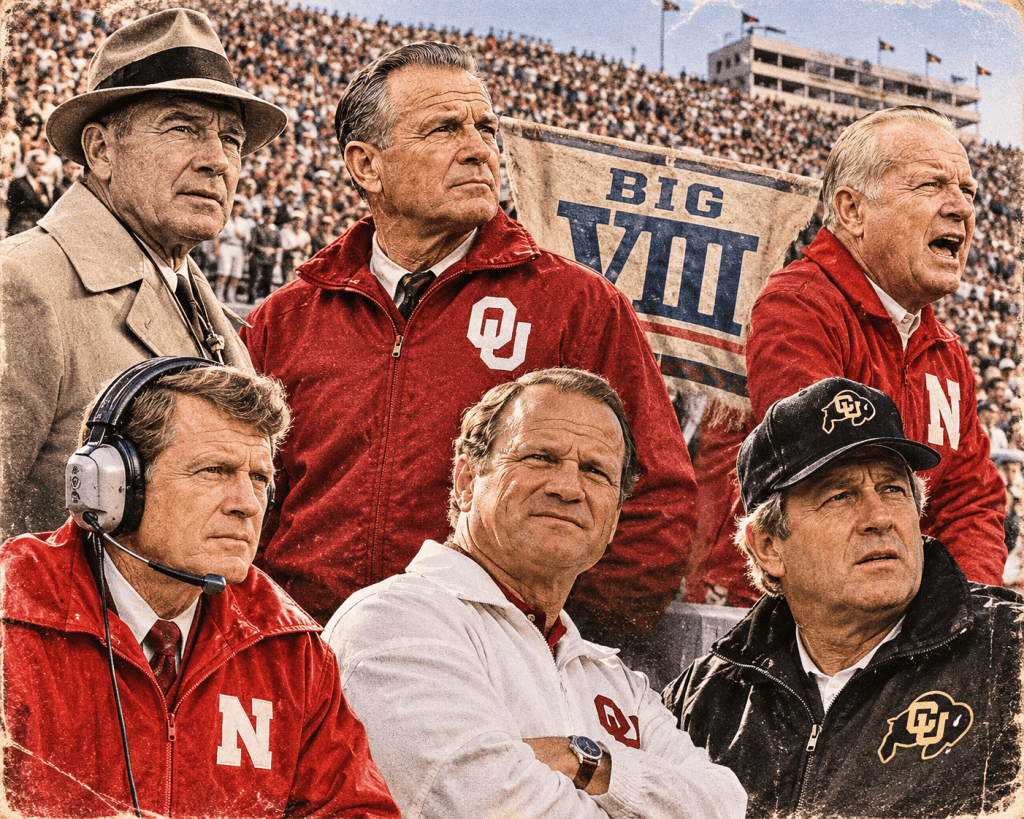
We took a look weeks ago at the storied history of the Big Eight conference. These weren’t just football programs. They were institutions, and behind many of their greatest moments stood a collection of coaches who helped define college football for generations.
Some built dynasties. Some changed the way the game was played. Others turned programs into national powers.
And if you grew up watching college football in the 1960s, 70s, 80s or 90s, chances are you remember these names.
Let’s take a trip back to the coaches who made the Big Eight legendary.
Don Faurot — Missouri
Before the Big Eight became the Big Eight, there was Don Faurot.
Faurot coached Missouri from 1935 through 1956, helping establish the Tigers as a legitimate force in the conference’s earlier Big Six and Big Seven days.
He won three conference championships and compiled a 101-79-10 record at Missouri.
But his greatest contribution may have been something that extended far beyond Columbia.
In 1941, Faurot developed the Split-T formation, an offensive innovation that would influence generations of college football offenses. Its principles eventually helped inspire formations such as the wishbone and veer.
Think about that for a moment. One of the most recognizable offensive approaches in college football history has roots in the mind of Missouri’s head coach.
Faurot wasn’t simply winning games. He was helping change the sport.
And the stadium where Missouri plays today carries his name: Faurot Field.
Bud Wilkinson — Oklahoma
If there was one coach who established Oklahoma as a national football powerhouse, it was Bud Wilkinson.
Taking over in 1947, Wilkinson transformed the Sooners into one of the most dominant programs college football had ever seen.
His overall record at Oklahoma was 145-29-4. His teams captured three national championships and 14 conference titles.
But the number that still sounds almost impossible is 47.
From 1953 through 1957, Oklahoma won 47 consecutive games, an NCAA major-college record that still stands.
The Sooners were practically unbeatable during that stretch. They won national championships in 1955 and 1956, and their 1950 team had also claimed the national title.
Wilkinson was more than a football coach. He was a teacher, an innovator and one of the most respected figures in the game.
By the time he left Oklahoma after the 1963 season, he had established a standard that future Sooner coaches would spend decades trying to maintain.
Bob Devaney — Nebraska
When Bob Devaney arrived in Lincoln in 1962, Nebraska was a respectable program looking for something more.
Devaney provided it.
In just a few seasons, he turned the Cornhuskers into a national powerhouse. His teams won 101 games during his 11 seasons as head coach, captured eight Big Eight championships and claimed national titles in 1970 and 1971.
The 1971 team remains one of the most celebrated college football teams ever assembled.
Led by quarterback Jerry Tagge, Johnny Rodgers, and a defense loaded with future professional talent, Nebraska finished undefeated and defeated Alabama, Colorado and Oklahoma along the way.
The victory over Oklahoma in the famous 1971 Game of the Century helped cement Nebraska’s place at the top of college football.
But Devaney’s greatest coaching decision may have come away from the field.
He hired a young assistant named Tom Osborne and eventually selected him as his successor.
That decision worked out rather well.
Tom Osborne — Nebraska
If Bob Devaney built the Nebraska dynasty, Tom Osborne turned it into a college football institution.
Osborne took over in 1973 and spent the next 25 seasons establishing one of the most remarkable coaching records in the history of the sport.
His final record was 255-49-3.
His teams won 13 conference championships and three national championships.
And then came the 1990s.
Nebraska’s teams of 1994 and 1995 were absolute juggernauts, winning consecutive national championships and overwhelming opponents with a combination of power football, speed and remarkable depth.
The 1995 team, which finished 12-0, is still frequently mentioned among the greatest teams ever to take the field.
Osborne’s teams were known for their strength in the trenches, their dominant running game and their ability to develop players.
He also brought a quieter personality to the sidelines than many of his contemporaries.
While other coaches might have been screaming at officials or making headlines, Osborne seemed perfectly comfortable letting the scoreboard do the talking.
And it usually did.
Barry Switzer — Oklahoma
If Tom Osborne represented the steady, methodical side of the Big Eight, Barry Switzer brought a different kind of personality to the sidelines.
Switzer took over Oklahoma in 1973 and immediately continued the dominance established by Bud Wilkinson.
His teams were fast, physical, confident and absolutely loaded with talent.
Over 16 seasons, Switzer compiled a 157-29-4 record, won 12 Big Eight championships and claimed three national championships.
His Sooners won national titles in 1974, 1975 and 1985.
The wishbone offense became synonymous with Oklahoma football, and Switzer had the players to make it nearly impossible to stop.
There was also plenty of personality.
Switzer was outspoken, colorful and never particularly interested in being understated. His Oklahoma teams played with an unmistakable swagger.
The rivalry with Nebraska became one of the defining matchups in college football, and Switzer was right in the middle of it.
When Oklahoma and Nebraska met, the stakes were rarely small.
Bill McCartney — Colorado
For years, Colorado was a respected program in the Big Eight, but Bill McCartney took the Buffaloes somewhere they had never been.
McCartney arrived in Boulder in 1982 and steadily built Colorado into a national contender.
His greatest achievement came in 1990.
The Buffaloes finished the season 11-1-1, defeated Notre Dame in the Orange Bowl and claimed a share of the national championship.
The team featured quarterback Darian Hagan, running back Eric Bieniemy and one of the most exciting offenses in the country.
McCartney’s Colorado teams won three Big Eight championships, and his 93 victories remain the most in school history.
He also helped create one of the most memorable rivalries in the conference.
Colorado’s rise made the annual Nebraska matchup even more important, and the two programs delivered some unforgettable November afternoons.
For a conference often dominated by Nebraska and Oklahoma, McCartney gave Colorado a seat at the championship table.
A Conference Defined by Its Coaches
Of course, these weren’t the only great coaches to walk the Big Eight sidelines.
Chuck Fairbanks continued Oklahoma’s success between the Wilkinson and Switzer eras. Missouri had its share of memorable coaches after Faurot. And the conference produced plenty of other outstanding football minds.
But the names above represent something special.
They helped turn the Big Eight into one of college football’s great football neighborhoods.
For decades, these coaches delivered national championships, undefeated seasons, legendary rivalries and some of the most memorable games the sport has ever witnessed.
There were no 12-team playoff brackets. No transfer portal. No NIL negotiations dominating the headlines.
There were eight schools, a collection of enormous football personalities and a whole lot of Saturday afternoons in the heartland.
And if you were lucky enough to experience it, you know just how special it was.
The Big Eight may be gone, but the coaches who built its legacy will never be forgotten.


Leave a Reply