There was a time when college football didn’t need a dozen divisions, endless conference realignment or coast-to-coast television footprints.
You could look at a map, find the middle of the country, and find some of the best football in America.
Welcome to the Big Eight.
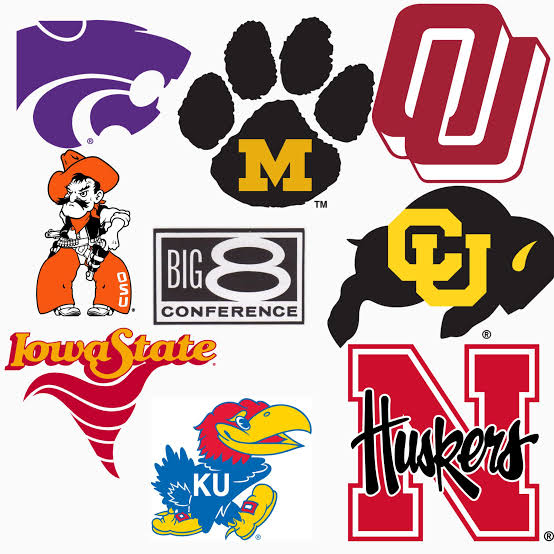
For generations, the Big Eight Conference was the heartbeat of college football in the Great Plains and Midwest. Nebraska. Oklahoma. Colorado. Missouri. Kansas. Kansas State. Iowa State. Oklahoma State.
Eight schools. Eight proud programs. And some of the fiercest rivalries in the sport.
The conference’s roots actually stretch back much further than the Big Eight name. The league was founded in 1907 as the Missouri Valley Intercollegiate Athletic Association before evolving into the Big Six, Big Seven and eventually the Big Eight. Oklahoma State’s arrival completed the familiar eight-team lineup.
And once those eight schools settled into place, something special happened.
Nebraska and Oklahoma
If you wanted to understand the Big Eight, you started with Nebraska and Oklahoma.
Their annual matchup became one of the most important games on the college football calendar. These weren’t simply conference rivals—they were programs competing for conference championships, national championships and a place in college football history.
The rivalry reached its legendary peak in 1971.
Nebraska entered the season as the defending national champion. Oklahoma was loaded. Colorado was also among the nation’s elite.
When the season ended, Nebraska was No. 1, Oklahoma No. 2 and Colorado No. 3 in the final AP poll—the only time in college football history that three teams from the same conference finished first, second and third.
And then there was “The Game of the Century.”
Nebraska defeated Oklahoma 35-31 in Norman on Thanksgiving weekend in 1971 in one of the most celebrated games in college football history.
That’s the Big Eight.
A Conference Built on Rivalries
What made the Big Eight so memorable wasn’t simply the number of great teams.
It was the history between them.
Kansas and Missouri played for the first time in 1891. Nebraska and Kansas met for the first time in 1892. Missouri and Nebraska also began their series in 1892.
By the time the Big Eight disappeared in 1996, many of these rivalries had already been going for generations.
The conference schedule was essentially a collection of college football history lessons.
Oklahoma-Nebraska.
Kansas-Missouri.
Oklahoma-Oklahoma State.
Kansas-Kansas State.
Missouri-Nebraska.
Colorado-Nebraska.
And on Saturdays in the fall, those games meant everything.
The Era of the Great Coaches
The Big Eight also became a proving ground for some of the greatest coaches in college football history.
Bud Wilkinson established Oklahoma as a national powerhouse. Barry Switzer continued that tradition. Bob Devaney and Tom Osborne transformed Nebraska into one of the sport’s defining programs.
Colorado produced national championship-caliber teams under Bill McCartney, while programs throughout the conference developed players who would become college football legends.
The conference was physical, competitive and deeply regional.
And nowhere was that identity stronger than in Nebraska.
The Cornhuskers won 20 conference championships during the Big Eight era, along with national championships in 1970, 1971, 1994 and 1995. Nebraska also produced Heisman Trophy winners Johnny Rodgers and Mike Rozier during the era.
By the 1990s, Nebraska had become an absolute machine.
The Cornhuskers won the final three Big Eight championships, including undefeated national championship seasons in 1994 and 1995.
Friday Night Lights? Try Saturday in the Plains.
Part of what made the Big Eight special was its sense of place.
These weren’t interchangeable franchises scattered across a national television map.
They belonged to their communities.
Memorial Stadium in Lincoln.
Memorial Stadium in Columbia.
Folsom Field in Boulder.
Kinnick-era Iowa State football at Ames.
The old stadiums, the marching bands, the rivalries and the traditions created an atmosphere that was uniquely Big Eight.
You knew where you were.
You knew who hated whom.
And you knew that November football in the Plains could change the national championship picture.
Then Everything Changed
By the 1990s, however, college football was changing.
Television became increasingly important. Conferences began thinking bigger. Regional boundaries mattered less.
In 1994, the Big Eight announced that it would join with four schools from the Southwest Conference—Texas, Texas A&M, Texas Tech and Baylor—to create a new 12-team league.
The Big Eight played its final season in 1995.
Nebraska won the final conference championship.
Then, in 1996, the Big Eight disappeared.
The Big 12 arrived.
Technically, it was a new conference rather than simply a renamed Big Eight; the Big 12 does not claim the Big Eight’s history as its own.
And just like that, one of college football’s great chapters closed.
The Big Eight Never Really Disappeared
The conference may be gone, but its fingerprints are everywhere.
Nebraska’s dominance remains one of the great dynasties in college football history.
Oklahoma’s tradition became one of the sport’s defining powers.
Colorado’s 1990 national championship remains a landmark moment.
Missouri, Kansas, Kansas State, Oklahoma State and Iowa State each carry traditions shaped by those decades of Big Eight football.
And the rivalries didn’t disappear simply because the conference did.
Some were interrupted. Others survived.
That’s the funny thing about college football.
Conferences can dissolve.
Television contracts can change.
Schools can move thousands of miles away.
But history doesn’t transfer quite so easily.
The Big Eight was more than a conference.
It was a place.
It was Nebraska on a cold November afternoon.
It was Oklahoma chasing another championship.
It was Colorado climbing the national rankings.
It was Missouri-Kansas and all the history that came with it.
It was eight schools spread across the heartland, connected by generations of football.
For nearly four decades, the Big Eight was one of the great stages in college football.
And even though the conference disappeared in 1996, the Big Eight remains one of the places where college football history still matters.
That’s Sports Americana.


Leave a Reply