One trip to the grocery store could change your entire afternoon.
A few dollars, a pack of baseball cards, and the possibility that somewhere inside that wrapper was your favorite player. Maybe a rookie card. Maybe a superstar. Maybe just another card of a guy you’d never heard of.
It didn’t matter. You had to open it.
Long before sports cards became multimillion-dollar collectibles, investment vehicles, and the subject of television auctions, they were something much simpler: a childhood obsession.
But the story of sports trading cards goes back much further than most of us realize.
Before the Gum, There Were Cigarettes
The earliest sports trading cards weren’t really intended for children at all.
During the late 19th and early 20th centuries, tobacco companies began including small collectible cards inside cigarette packages. The cards helped stiffen the packaging and gave customers another reason to buy a particular brand.
Baseball quickly became a natural fit.
Players were featured on colorful cards, often with portraits, team information, and statistics. They were advertisements, but they also became collectibles.
One card from this era would eventually become the most famous baseball card in the world.
The 1909-1911 T206 Honus Wagner.
Wagner, one of baseball’s greatest players, reportedly objected to his image being used in a tobacco promotion. Production of his card was stopped, leaving very few examples in circulation.
What began as a promotional insert became a legendary rarity. More than a century later, the Honus Wagner card would become one of the most valuable pieces of sports memorabilia ever produced.
Not a bad return on a cigarette advertisement.
Topps Changes Everything
By the 1950s, sports cards were finding a much younger audience.
The Topps Chewing Gum Company helped transform the hobby by combining baseball cards with the simple pleasure of buying a pack of gum.
In 1952, Topps released its landmark baseball card set. The cards featured colorful player portraits, team identification, and statistics on the back.
The design helped establish the format generations of collectors would recognize.
And then there was Mickey Mantle.
His 1952 Topps card would become one of the most recognizable collectibles in sports history. It is now considered one of the hobby’s crown jewels.
But back then, nobody was talking about million-dollar valuations. Kids were looking for their favorite players, hoping to complete a set, and trying to convince their friends to trade away a card they desperately wanted.
The cards were the attraction. The gum was the bonus.
The Golden Age of the Wax Pack
For many people, the real magic happened in the 1970s and 1980s.
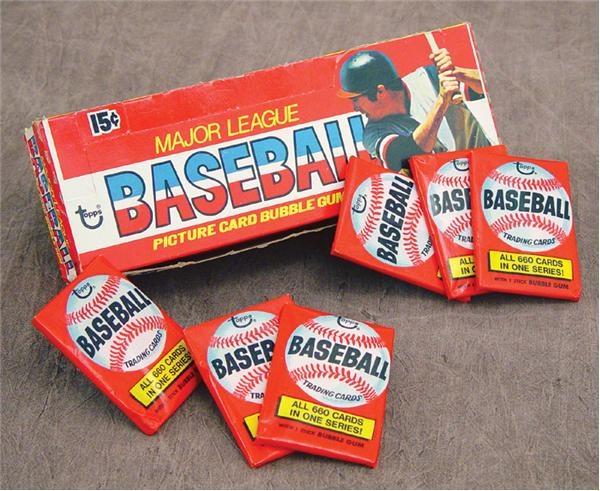
This was the era of the wax pack.
You could find them at the grocery store, the drugstore, the convenience store, or just about anywhere that sold candy. The familiar packaging, the smell of fresh cardboard, and the anticipation of discovering who was inside made opening a pack an experience of its own.
There were stars to collect, rookies to discover, and complete sets to chase.
Topps baseball cards became a yearly ritual. Fleer and Donruss eventually joined the competition, giving collectors even more cards to chase.
And the trading?
That was an entirely different economy.
Two cards for one. Five commons for a superstar. A friend who insisted his third baseman was worth your best pitcher. There was always somebody who thought they were getting the better end of the deal.
Cards were traded on playgrounds, at lunch tables, in backyards, and sometimes with the kind of seriousness usually reserved for Wall Street.
Every kid had a system.
Some organized their cards by team. Others sorted them by player. Some kept their best cards in protective plastic holders while the rest lived in shoeboxes, rubber-banded stacks, or whatever container was available.
And somewhere in almost every neighborhood, there was a kid who knew every player’s statistics by heart.
When We All Thought We Were Rich
Then came the collecting boom of the late 1980s and early 1990s.
Suddenly, sports cards weren’t just something to enjoy. They were investments.
Beckett price guides became essential reading. Kids and adults alike studied card values, searched for rookie cards, and began imagining what their collections might be worth someday.
The problem?
Everybody was collecting.
Manufacturers printed enormous quantities of cards, and the market became flooded. What seemed like a guaranteed investment often turned out to be a shoebox full of cards that were worth considerably less than the price of the plastic sleeves protecting them.
We all knew somebody who was convinced his collection would pay for college.
Somewhere in an attic, that collection is probably still waiting for its big payday.
More Than a Piece of Cardboard
Today, sports cards are a completely different business.
Professional grading, online auctions, rare parallels, autograph cards, and multimillion-dollar sales have transformed collecting into a sophisticated marketplace.
But the underlying appeal hasn’t really changed.
It’s still about the possibility of finding something special.
It’s about the player on the front, the statistics on the back, and the memories attached to a particular season.
For those of us who grew up with them, sports cards were a connection to the games and players we loved. They were a way to own a little piece of sports history before we even understood what sports history meant.
And maybe that’s why the old cards still mean so much.
Because somewhere in a closet, basement, or attic, there’s probably a shoebox full of cardboard that takes somebody right back to being ten years old.
Before the grading companies. Before the auctions. Before the million-dollar valuations.
There was just a kid, a pack of cards, and the hope that the next one would be a superstar.


Leave a Reply