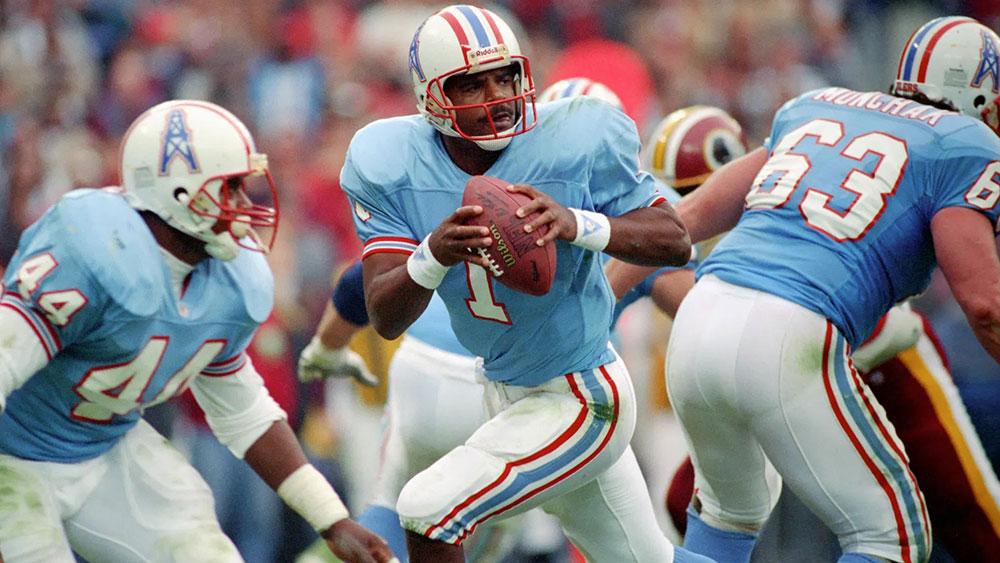
There was a time when NFL football was supposed to be about establishing the run, controlling the clock and pounding the opposing defense into submission.
Then came the Houston Oilers.
In the late 1980s and early 1990s, the Oilers decided that throwing the football 50 times a game wasn’t some sort of emergency measure. It was the plan.
And they had the perfect quarterback to make it work.
His name was Warren Moon.
Football’s Version of a Fast Break
The story of the Run-and-Shoot actually began before the Oilers made it famous. Developed by offensive innovator Mouse Davis, the system emphasized spacing, timing, four wide receivers and an almost endless assortment of adjustments between quarterbacks and receivers.
The idea was simple in theory: spread the defense out, make defenders cover the entire field, and let your quarterback make them pay.
Houston began incorporating these concepts under Jerry Glanville, whose version became known as the Red Gun. When Glanville departed after the 1989 season, new head coach Jack Pardee and offensive coordinator Kevin Gilbride took things even further.
By 1990, the Oilers were running the full-blown Run-and-Shoot.
And it was something to watch.
Warren Moon Was the Perfect Man for the Job
Moon wasn’t your typical NFL quarterback.
Before arriving in Houston, he had spent six seasons tearing up the Canadian Football League with the Edmonton Eskimos. He could throw deep, make quick decisions and deliver the football from just about anywhere on the field.
Now he had an offense designed to let him loose.
The receiving corps featured Ernest Givins, Haywood Jeffires, Drew Hill and Curtis Duncan. Defenses couldn’t simply concentrate on one receiver. Everybody was involved, and the routes could change depending on what the defense showed.
In December 1990, Moon threw for an astonishing 527 yards against Kansas City.
The Oilers were averaging more than 300 passing yards per game. Defensive coordinators were spending their Sundays trying to figure out how to stop something that looked more like a college basketball fast break than traditional professional football.
And Houston wasn’t just entertaining. It was winning.
The Astrodome Was the House of Pain
The Oilers had a personality that matched their offense.
Jerry Glanville had his black clothing, sunglasses and outlaw attitude. The defense featured characters like linebacker Robert Brazile’s successor, the hard-hitting Keith McCants, and the unforgettable head coach Jack Pardee brought a new identity to the team.
The Astrodome became known as the House of Pain.
Houston was putting up points in bunches, and the Run-and-Shoot was becoming one of the most talked-about offensive systems in professional football.
From 1990 through 1992, the Oilers ranked first in the NFL in passing yards, averaging nearly 4,500 per season.
They were ahead of their time.
The Problem? January Football.
For all the offensive fireworks, Houston couldn’t quite get where it wanted to go.
The 1990 Oilers finished 9-7 before losing to Cincinnati in the playoffs. The following season brought another playoff appearance, but no breakthrough.
And then came January 3, 1993.
Houston led the Buffalo Bills 35-3 in a wild-card playoff game. It looked like the Oilers were finally headed toward a statement victory.
Instead, Buffalo staged the greatest comeback in NFL history, winning 41-38 in overtime.
The Run-and-Shoot could overwhelm a defense, but it couldn’t protect a lead that afternoon.
It was a devastating ending for a team that had spent years making Sundays exciting.
Ahead of Their Time
The Houston Oilers eventually faded, and the Run-and-Shoot never became the dominant NFL system its early believers imagined.
But look at today’s NFL.
Four-receiver formations, spread concepts, option routes, shotgun formations and quarterbacks asked to make quick decisions based on defensive coverage are now everyday football.
The league eventually moved toward the kind of passing game Houston was experimenting with decades ago.
Warren Moon deservedly earned his place in the Pro Football Hall of Fame. And those Oilers teams deserve to be remembered as more than just another group that couldn’t win the big one.
They were different. They were daring. And they were a whole lot of fun.
For a few seasons, the Houston Oilers made the NFL feel like it was watching the future arrive early.
And they did it in powder blue.


Leave a Reply