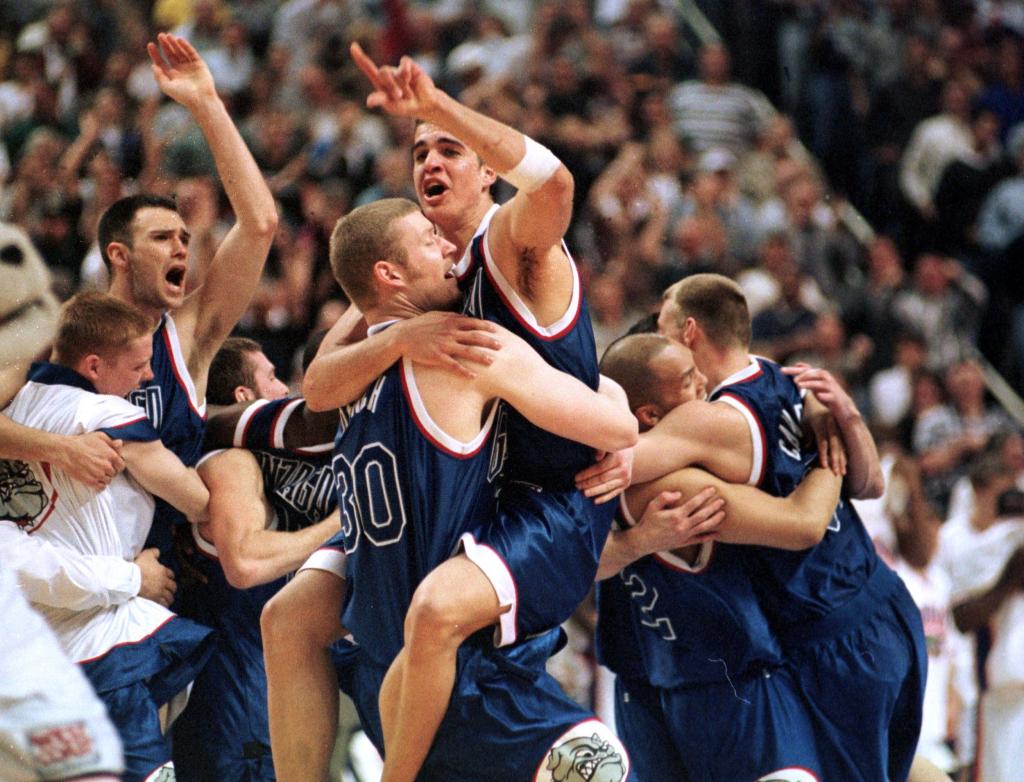
There was a time when Gonzaga basketball was little more than a trivia question.
Where did John Stockton play his college basketball?
That’s right. Gonzaga.
But in the 1990s, the small Jesuit university in Spokane, Washington, was hardly a household name. The Bulldogs played in the West Coast Conference, operated with a modest budget, and rarely received much national attention.
Today, Gonzaga is a perennial NCAA Tournament team, a national championship runner-up, and one of the most respected programs in college basketball.
So how exactly did that happen?
It started with a group of coaches who believed a little school in the Pacific Northwest could compete with anybody.
The foundation
In 1989, a young Mark Few joined head coach Dan Fitzgerald’s coaching staff as a graduate assistant. He would eventually become one of the most successful coaches in college basketball history.
Dan Monson joined the staff in the early 1990s, and the coaching group began assembling a foundation that included players such as Jeff Brown, Matt Santangelo, Richie Frahm, and Casey Calvary.
Gonzaga made its first NCAA Tournament appearance in 1995, but the program was still largely invisible nationally.
Then came 1997.
At the Top of the World Classic in Fairbanks, Alaska, Gonzaga knocked off Tulsa, Mississippi State, and No. 5 Clemson. That Clemson victory was particularly important. The Bulldogs were beginning to realize they could compete with established programs.
The pieces were coming together.
March 1999: The world meets Gonzaga
The 1998-99 season changed everything.
Under Monson, Gonzaga put together a tremendous season and earned an NCAA Tournament berth as a No. 10 seed.
Then the fun began.
The Bulldogs defeated Minnesota and Stanford to reach the Sweet 16.
Against Florida, Gonzaga produced one of the most memorable finishes in tournament history. With the game tied in the closing seconds, sophomore Casey Calvary tipped in a missed shot to give the Bulldogs a stunning 73-72 victory.
Suddenly, the little school from Spokane was headed to the Elite Eight.
The run ended against eventual national champion Connecticut, which survived 67-62.
But Gonzaga had arrived.
People who had never heard of the school were suddenly trying to figure out how to pronounce its name.
The most important decision came next
Here’s where the story gets really interesting.
After the magical 1999 season, Dan Monson left Gonzaga to become the head coach at Minnesota.
For most smaller programs, losing a coach after a historic tournament run can be devastating.
Gonzaga had a different plan.
They promoted assistant Mark Few.
Few had been part of the program’s development since 1989, understood the culture, and believed the Bulldogs could become something much bigger.
He wasn’t interested in being a one-year Cinderella.
He wanted to build a permanent winner.
And that’s exactly what happened.
Gonzaga reached the Sweet 16 again in 2000 and 2001. Players such as Dan Dickau, Ronny Turiaf, Blake Stepp, and Adam Morrison helped establish the Bulldogs as a regular national presence.
The program invested in facilities, recruiting, scheduling, and television exposure. Winning attracted better players, better players brought more winning, and the resources continued to grow.
It became a remarkable cycle.
From Cinderella to national powerhouse
By the mid-2000s, Gonzaga wasn’t some cute underdog story anymore.
They were regularly ranked in the national polls, earning NCAA Tournament bids, and competing with the biggest names in college basketball.
In 2017, Few finally took the Bulldogs to their first Final Four.
Four years later, Gonzaga reached the national championship game again, this time finishing an undefeated regular season before falling to Baylor in the title game.
Think about that transformation.
A program that once struggled to attract national attention had become a destination for elite basketball talent.
And Mark Few was still there.
That’s perhaps the most remarkable part of the entire story. The coach who helped build the foundation stayed to see the program become something nobody could have reasonably imagined when he arrived in Spokane.
Gonzaga didn’t become a college basketball power overnight.
It took vision, smart recruiting, strategic investment, continuity, and a group of people who refused to accept that a small school had to think small.
Sometimes the greatest Cinderella stories don’t end at midnight.
Sometimes they build a dynasty.


Leave a Reply