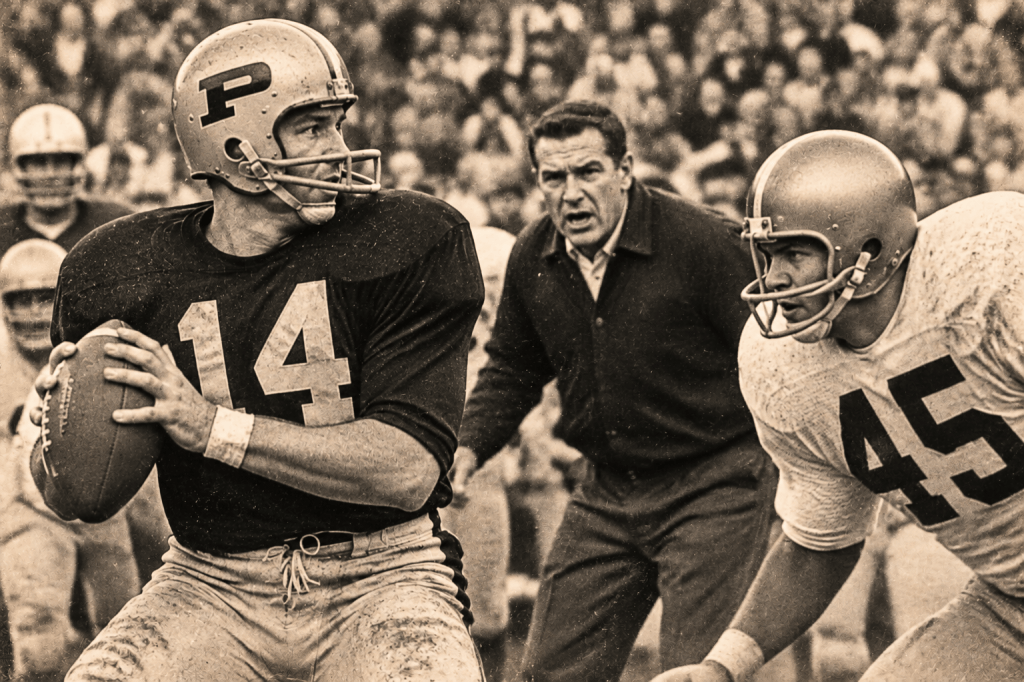
College football has always had its share of stolen signals, mysterious play calls and coaches looking for any possible advantage.
But what if one of the most unusual cheating allegations in the sport involved something much simpler than an elaborate sign-stealing operation?
A telephone.
The story dates back to the 1960s, when Purdue and Notre Dame were two of the biggest names in Midwestern college football. Notre Dame had Ara Parseghian on the sidelines, Terry Hanratty at quarterback, and a reputation that made every opponent circle the game on its calendar.
And then came an unsettling afternoon against Purdue.
According to a remarkable account published in 2002 by former Northwestern sports information director and broadcaster George Beres, Notre Dame’s offense appeared to have an almost impossible problem.
Quarterback Terry Hanratty would look to the sideline for a coded hand signal from Parseghian. He would then relay the play to his teammates.
But something seemed wrong.
According to Beres, Purdue’s defense repeatedly appeared to know exactly what was coming. Hanratty reportedly found himself changing plays at the line again and again, struggling to get the offense organized while the home crowd roared.
It was the sort of afternoon that could leave a quarterback questioning everything.
And Parseghian apparently questioned himself.
Beres later recalled that Parseghian was unusually upset after the game, believing Notre Dame’s signals had somehow been compromised.
The mystery began to unravel several weeks later.
Beres was in West Lafayette with Northwestern when his broadcasting partner, Ed Wheeler, discovered something unusual while checking the stadium’s telephone connections.
Wheeler reportedly found that a phone at the Purdue bench was connected to the visiting team’s telephone system.
In other words, there appeared to be a way for someone on the home sideline to listen in on communications intended for the visiting coaches.
Wheeler alerted Northwestern coach Alex Agase, who had previously worked alongside Parseghian at Northwestern. The discovery suddenly gave Parseghian’s earlier suspicions a possible explanation.
The matter eventually reached the Big Ten office. According to Beres, the conference privately warned Purdue that it would be watched closely to prevent future accusations of telephone tampering.
Purdue was never publicly established as having committed the alleged act, and the university had no one from the 1960s available to comment when Beres revisited the story decades later.
That’s an important distinction.
Still, the story is fascinating because it offers a glimpse into an era when football communications were far less sophisticated than they are today.
There were no elaborate digital headsets, encrypted communications or elaborate sideline technology. There were telephones, wires, hand signals and coaches trying to stay one step ahead of the opposition.
Apparently, sometimes the most important piece of equipment on the sideline wasn’t a clipboard or a playbook.
It was a telephone.
And somewhere in the forgotten history of college football, there remains one wonderfully strange question:
Was somebody listening?


Leave a Reply