There was a time when the NBA Finals weren’t considered appointment television.
In fact, there was a time when you could miss the biggest game of the basketball season, turn on the television after the evening news, and still catch it.
That’s because, in the late 1970s and early 1980s, the NBA was fighting for its television life. Ratings were falling, attendance was struggling, and the league was battling an image problem. Professional basketball was a distant third behind football and baseball in the American sports conversation.
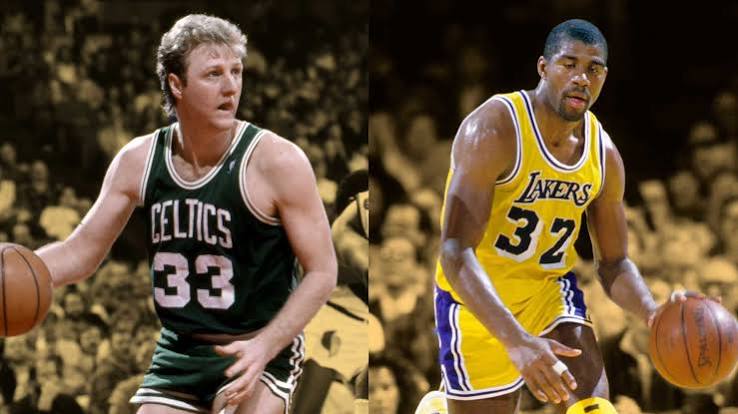
And then came two players who had already given the country a reason to watch basketball.
Their names were Larry Bird and Magic Johnson.
The NBA’s television problem
By the late 1970s, the NBA had a serious problem.
The league had talented players. Kareem Abdul-Jabbar was still dominating. Julius Erving was one of the most exciting athletes in sports. But the NBA was struggling to turn those stars into a national television audience.
There were concerns about drug use, player behavior, declining attendance and a lack of recognizable personalities for casual fans. Television ratings reflected the trouble.
CBS, which held the NBA’s national television rights, wasn’t exactly treating the league like a prized possession.
Games were pushed into late-night time slots. Some playoff games were shown after local news broadcasts. And the situation would get even more embarrassing.
When the NBA Finals lost to reruns
The 1980 NBA Finals featured the Los Angeles Lakers and Philadelphia 76ers. It should have been a showcase for the sport.
Instead, Game 6 became one of the most remarkable television stories in NBA history.
The Lakers had a chance to win the championship. Kareem Abdul-Jabbar was injured, leaving rookie Magic Johnson to take over at center.
Johnson responded with a performance for the ages: 42 points, 15 rebounds and seven assists. The Lakers won 123-107, and Magic helped deliver the championship.
But much of America didn’t get to watch it live.
CBS chose to show the game on tape delay in most markets, airing it at approximately 11:30 p.m. Eastern. The network didn’t want to disrupt its prime-time lineup, which included reruns of The Dukes of Hazzard and Dallas.
Read that again.
A potential championship-clinching NBA Finals game, featuring a rookie who was about to become a superstar, was pushed aside for television reruns.
The league had reached a remarkable low point.
A college basketball game changed everything
There was, however, a glimpse of what basketball could become.
On March 26, 1979, Michigan State and Indiana State met in the NCAA championship game. Michigan State had Magic Johnson. Indiana State had Larry Bird.
The matchup became a national sensation.
The game drew a 24.1 television rating, making it the highest-rated college basketball championship game in history. Millions of Americans watched two players who would soon become the faces of the NBA.
It was the perfect preview of what was coming.
Bird joined the Boston Celtics. Magic joined the Los Angeles Lakers. Their rivalry was no longer just about two college stars who had met on the biggest stage. It became a rivalry between two of the NBA’s most recognizable franchises.
And suddenly, basketball had a story that television audiences couldn’t ignore.
The rivalry that changed the league
Bird and Magic couldn’t have been more different.
Bird was the hard-nosed, trash-talking competitor from French Lick, Indiana. Magic was the charismatic showman from Lansing, Michigan, whose smile seemed as big as his game.
One played for Boston. The other played for Los Angeles.
They represented two different basketball cultures, two different personalities and two cities that already had plenty of reasons to dislike one another.
Their teams met in the NBA Finals in 1984, 1985 and 1987. The Lakers won two of those series, while Boston took the first.
More importantly, the rivalry gave the NBA something it desperately needed: a national television attraction.
The league wasn’t simply selling basketball anymore. It was selling characters, competition, personalities and a rivalry that fans wanted to see again.
The NBA’s television fortunes improved, and the league began to look like a very different business.
The beginning of a basketball boom
The Bird-Magic rivalry didn’t single-handedly save the NBA. The league had other stars, strong franchises and important leadership changes ahead. David Stern became commissioner in 1984, and Michael Jordan arrived that same year.
But Bird and Magic helped make the NBA relevant to a national audience again.
They made the Celtics-Lakers rivalry must-see television. They helped turn the NBA Finals into an event. And they created the foundation for the superstar era that would follow.
By the time Jordan was taking over the basketball world, the NBA was no longer asking television networks for a seat at the table.
It was becoming one of the biggest attractions in sports.
It’s almost impossible to imagine today, but there was a time when the NBA Finals had to wait until after the reruns were over.
And all it took to help change that was a kid from Indiana, a kid from Michigan, and a rivalry that would define a generation.
Sometimes the greatest thing to happen to a sport isn’t a new rule, a new television contract or a new arena.
Sometimes it’s two guys who just can’t stand losing to each other.


Leave a Reply