Imagine preparing all season for the Rose Bowl, only to discover that the game you’ve dreamed about is being moved nearly 3,000 miles across the country.
That’s exactly what happened to Oregon State in December 1941.
And the story behind it is one of the strangest, most fascinating chapters in college football history.
Pearl Harbor Changes Everything
On December 7, 1941, the Japanese attack on Pearl Harbor changed the United States forever. Suddenly, the possibility of another attack on the West Coast became a very real concern.
The Rose Bowl, traditionally played in Pasadena, California, was in jeopardy. Military restrictions and fears surrounding large public gatherings made holding the game on the West Coast an unacceptable risk.
Enter Duke University.
Duke’s legendary head coach, Wallace Wade, offered to host the game in Durham, North Carolina. The proposal was accepted, and suddenly the Rose Bowl had a new home.
There was just one small detail: Oregon State and Duke would be playing nearly 3,000 miles from where the game was supposed to take place.
A Rose Bowl in Someone Else’s Backyard
Duke’s stadium normally held approximately 35,000 spectators. That wasn’t going to be enough.
The university borrowed bleachers from neighboring North Carolina and NC State, expanding the capacity to approximately 56,000. Tickets sold out in just three days.
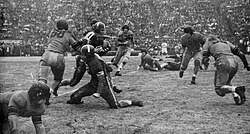
On January 1, 1942, the Rose Bowl was played in Durham for the first—and only—time in its history.
Duke entered the game unbeaten and was considered a heavy favorite. The Blue Devils had home-field advantage, a perfect season behind them, and the support of a packed stadium.
Oregon State, meanwhile, was hardly expected to spoil the party.
But football has a funny way of ignoring expectations.
The Beavers battled the Blue Devils through a rainy afternoon, and the game was tied 14-14 in the third quarter. Then came the play that would make college football history.
Oregon State quarterback Bob Dethman connected with Gene Gray on a 68-yard touchdown pass, giving the Beavers the lead.
Duke managed a fourth-quarter safety, but Oregon State held on for a stunning 20-16 victory.
The Player Who Never Made the Trip
There is another part of this story that deserves to be remembered.
Oregon State sophomore Jack Yoshihara was supposed to be part of the team making the historic journey east. But Yoshihara was Japanese American, and wartime restrictions prevented him from traveling more than 35 miles from his home on the West Coast.
While his teammates boarded the train for Durham, Yoshihara stayed behind.
He listened to the game on the radio and would later spend time at the Minidoka incarceration camp in Idaho.
Think about that for a moment. His teammates were participating in one of the most memorable games in college football history, while Yoshihara was being denied the opportunity because of his ancestry.
It is a sobering reminder that the events of World War II reached far beyond the battlefield and into the everyday lives of Americans.
A Rose Bowl That Never Happened Again
The 1942 Rose Bowl remains the only one ever played outside Pasadena.
Duke’s Wallace Wade would soon leave coaching to serve in the military. Many players from both teams would also go on to serve during World War II.
The game itself was eventually remembered as much for its unusual setting as for Oregon State’s upset victory.
Every January, the Rose Bowl returns to Pasadena. The floats, the pageantry, the sunshine, and the traditions remain.
But there was one January afternoon when the Rose Bowl belonged to Durham, North Carolina.
And somewhere in the history of college football, there is a pretty remarkable story about a team that traveled across the country, walked into its opponent’s backyard, and left with the most unusual Rose Bowl victory of all time.
Sports Americana. Because some of the greatest stories in sports history deserve another look.


Leave a Reply