If you think today’s Olympic Games occasionally produce a little controversy, you should probably take a look at what happened during the 1904 Summer Olympics in St. Louis.
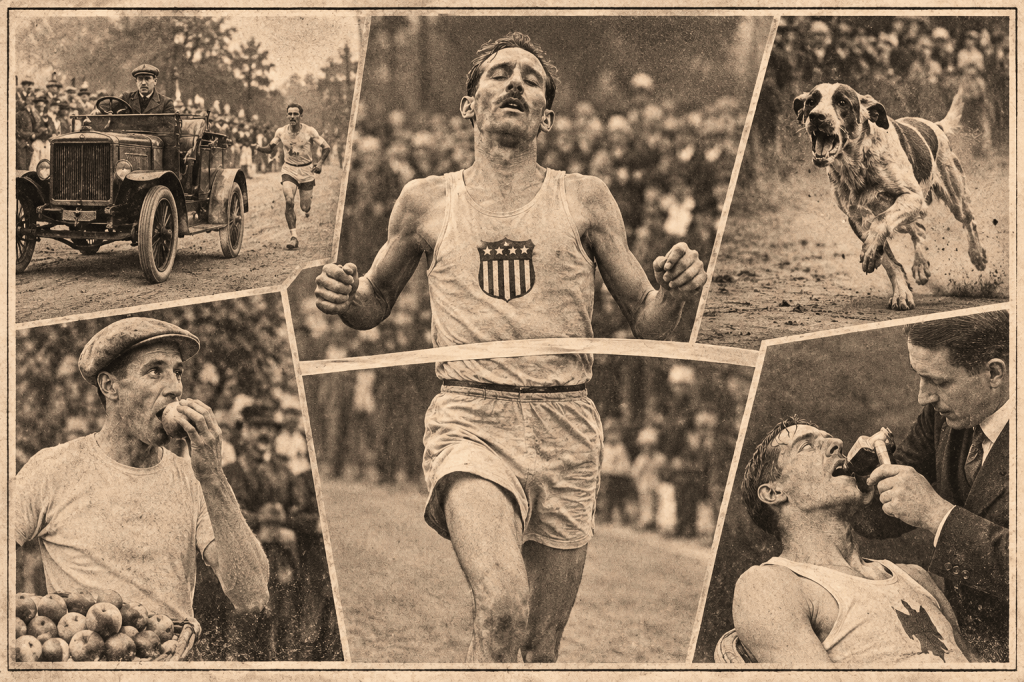
There was a runner who took an automobile shortcut. Another who was chased off course by wild dogs. A Cuban competitor who stopped to steal fruit along the route. And the eventual gold medalist? He needed a little help from something commonly used to kill rats.
Welcome to the 1904 Olympic marathon. Apparently, nobody had quite figured out how to organize one of these things yet.
The race took place on August 30, 1904, under brutally hot conditions. The course was dusty, hilly, and roughly 26 miles long. There was just one official water station along the route, and Olympic organizers actually wanted to study the effects of dehydration on athletes.
Yes, seriously.
Of the 32 competitors, only 14 would make it to the finish.
The Cuban Who Made a Few Snack Stops
One of the more entertaining characters was Félix Carvajal, a Cuban mailman who had traveled to St. Louis with very little money.
Carvajal reportedly raised funds to make the trip, arrived in his everyday clothes, and even had his trousers cut shorter before the race.
He wasn’t exactly dressed like a professional marathoner.
Along the route, Carvajal stopped to chat with spectators, sampled some fruit, and reportedly helped himself to peaches from a roadside orchard. Unfortunately, some of the fruit left him with stomach cramps.
Somehow, he still managed to finish fourth.
Not bad for a guy who apparently treated the Olympic marathon like a sightseeing tour with occasional snacks.
The Runner Who Took a Shortcut
Then there was Fred Lorz.
Lorz was an American runner who developed cramps and dropped out of the race before the halfway point. Rather than call it a day, he climbed into an automobile and rode for approximately 11 miles.
Eventually, the car broke down, and Lorz returned to running.
He entered the stadium, crossed the finish line, and was initially celebrated as the Olympic marathon champion.
There was only one small problem.
He hadn’t actually run the entire race.
The deception was quickly exposed, and Lorz admitted that the whole thing had been intended as a joke. Officials weren’t laughing. He was suspended from amateur competition, although the suspension was later lifted.
For what it’s worth, Lorz returned to win the Boston Marathon in 1905.
An interesting career detour, to say the least.
The Gold Medalist and His Unusual Performance Enhancer
But the strangest story belonged to the actual winner, Thomas Hicks.
Hicks was an experienced American distance runner, and by the later stages of the race, he was in serious trouble. He was exhausted, dehydrated, and struggling to keep moving.
His handlers decided he needed a little assistance.
Their solution?
Strychnine.
That’s right. The same poisonous substance historically used in rat poison.
In small doses, strychnine was once believed to act as a stimulant. Hicks was given a mixture containing strychnine and egg whites, followed by another dose later in the race. He also received some brandy.
Modern sports medicine would probably have a few objections.
Hicks staggered toward the finish, barely able to keep moving. His handlers helped him along, and he eventually crossed the line in 3 hours, 28 minutes and 53 seconds.
He was the Olympic champion.
He was also in such poor condition afterward that he needed medical attention.
One More Thing About Those Conditions…
The race was so poorly organized and physically punishing that one competitor, William Garcia, nearly died after collapsing along the course. The thick dust kicked up by automobiles and runners contributed to severe internal bleeding.
Another competitor, South African runner Len Tau, was reportedly chased nearly a mile off course by a wild dog.
And remember, these were the Olympic Games. Not some questionable local road race organized by a guy with a stopwatch and a cooler of warm Gatorade.
A Marathon Nobody Will Ever Forget
Thomas Hicks went home with the gold medal. Fred Lorz eventually became a Boston Marathon champion. Félix Carvajal became one of the more memorable characters in Olympic history.
And the 1904 marathon became one of the most bizarre sporting events ever staged.
In fact, the race was so disastrous that Olympic organizers questioned whether the marathon should remain part of the Games.
Fortunately, it did.
But the next time somebody complains about a marathon being too hot, a water station being too far away, or the competition being unfair, remember St. Louis in 1904.
At least today’s runners don’t have to worry about getting passed by an automobile, chased by a dog, or being handed rat poison at mile 19.
Somewhere, Thomas Hicks is probably still wondering why they didn’t just give him a bottle of water.


Leave a Reply