Imagine it’s October 1943.
Somewhere in Europe, American soldiers are preparing for another day of war. In the Pacific, Marines are fighting their way across islands most Americans had never heard of a few years earlier.
Back home, families are rationing gasoline, saving scrap metal, and anxiously awaiting letters from loved ones overseas.
And in New York, the Yankees are playing the St. Louis Cardinals in the World Series.
Yes, the World Series.
Because even with the world seemingly coming apart, America still had baseball.
And the stories behind the World Series played during the two World Wars are some of the most fascinating, and strangely comforting, in sports history.
World War I: The World Series That Couldn’t Wait Until October
In 1918, the United States was fully involved in World War I, and baseball was beginning to feel the consequences.
Players were leaving for military service. Rosters were changing. The government had implemented a policy known as the “Work or Fight” order, requiring draft-eligible men to participate in essential work or face military service.
Major League Baseball couldn’t simply operate as usual.
So the season ended early, and the World Series began on September 5.
That’s right. The Fall Classic wasn’t even played in the fall.
The Boston Red Sox faced the Chicago Cubs, with a 23-year-old pitcher named Babe Ruth taking the mound in Game 1.
Yes, that Babe Ruth.
Before he became the greatest home run hitter the game had ever seen, Ruth was busy throwing shutouts in the World Series.
He blanked the Cubs 1-0 in the opener, and Boston eventually won the championship in six games.
But something else happened during that series that would change American sports forever.
The Day the National Anthem Became a Baseball Tradition
During Game 1 of the 1918 World Series at Chicago’s Comiskey Park, a military band played “The Star-Spangled Banner” during the seventh-inning stretch.
With American servicemen in attendance and the war weighing heavily on the country, the moment carried special significance.
The song had been performed at baseball events before, but this particular wartime performance helped establish a tradition that eventually became inseparable from American sports.
Think about that.
A tradition we barely give a second thought to today grew in part from a baseball game played while American soldiers were fighting overseas.
And baseball was about to face an even greater test just two decades later.
World War II: When the President Said, “Play Ball”
Following the attack on Pearl Harbor in December 1941, America entered World War II.
Suddenly, there was a very real question about whether professional baseball should continue.
Commissioner Kenesaw Mountain Landis wrote to President Franklin D. Roosevelt asking for his thoughts.
Roosevelt’s response, dated January 15, 1942, became known as the famous “Green Light Letter.”
He believed baseball should continue.
Not because baseball was more important than the war. Quite the opposite.
Because Americans working long hours in factories, worrying about loved ones overseas, and sacrificing for the war effort deserved an occasional afternoon at the ballpark.
Roosevelt also made clear that eligible ballplayers should serve their country.
And serve they did.
More than 500 major leaguers entered military service during World War II, including Ted Williams, Joe DiMaggio, Bob Feller, and Hank Greenberg.
Imagine today’s Major League Baseball suddenly losing hundreds of players, including some of its biggest superstars.
Now imagine the league simply continuing anyway.
That’s essentially what happened.
The Wartime World Series: 1942–1945
1942: St. Louis Cardinals defeated New York Yankees 4–1
1943: New York Yankees defeated St. Louis Cardinals4–1
1944: St. Louis Cardinals defeated St. Louis Browns 4–2
1945: Detroit Tigers defeated Chicago Cubs 4–3
The 1943 Yankees won without Joe DiMaggio, Phil Rizzuto, and Red Ruffing, among others, who were serving in the military.
Travel restrictions also affected the schedule. Rather than the usual back-and-forth between cities, the first three games were played in New York, with the remaining games scheduled for St. Louis.
Even the logistics of the World Series had become part of the war effort.
1944: The World Series That Never Left St. Louis
Of all the wartime World Series, perhaps none was stranger than 1944.
The St. Louis Cardinals faced the St. Louis Browns.
Both teams played their home games at Sportsman’s Park, which meant the entire World Series was played in one stadium.
No cross-country travel. No overnight trains. No worrying about where the next game would be played.
Just six games in the same ballpark.
The Browns were making their first World Series appearance, while the Cardinals had become one of baseball’s dominant franchises.
The Cardinals won in six games, but the matchup became one of the most unusual championships in baseball history.
And all of it happened while American forces were fighting across Europe and the Pacific. Baseball Hall of Fame
1945: A World Series in a Changed World
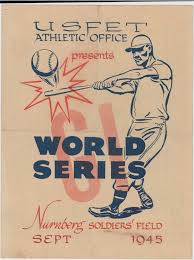
By October 1945, the war was finally over.
Germany had surrendered in May. Japan had formally surrendered in September.
For the first time in years, Americans could follow the World Series without the uncertainty of an ongoing global war.
The Detroit Tigers defeated the Chicago Cubs in seven games.
It was a championship played in a country beginning to welcome its servicemen home.
Baseball’s biggest stars would gradually return, too.
And the sport would begin the transition from wartime necessity back to something resembling normal life.
More Than Just Baseball
Here’s what I find so remarkable about these World Series.
We tend to remember baseball history through statistics, championships, and legendary players.
Babe Ruth’s home runs. The Yankees’ dynasties. The Cubs’ championship drought.
But sometimes the most important part of a baseball game has nothing to do with who won.
In 1918, Americans attended the World Series while the First World War was still raging.
In 1943, families could listen to the Yankees and Cardinals on the radio while worrying about sons, husbands, and brothers thousands of miles away.
In 1944, an entire World Series took place in one St. Louis ballpark while the nation fought a war on two fronts.
And through it all, baseball offered something Americans desperately needed.
A little normalcy.
A familiar voice on the radio.
A box score in the morning newspaper.
Nine innings when the rest of the world could wait.
The World Series didn’t stop the wars. It couldn’t bring anyone home.
But for a few hours, it gave a sense of normalcy to a country living through uncertain times.


Leave a Reply