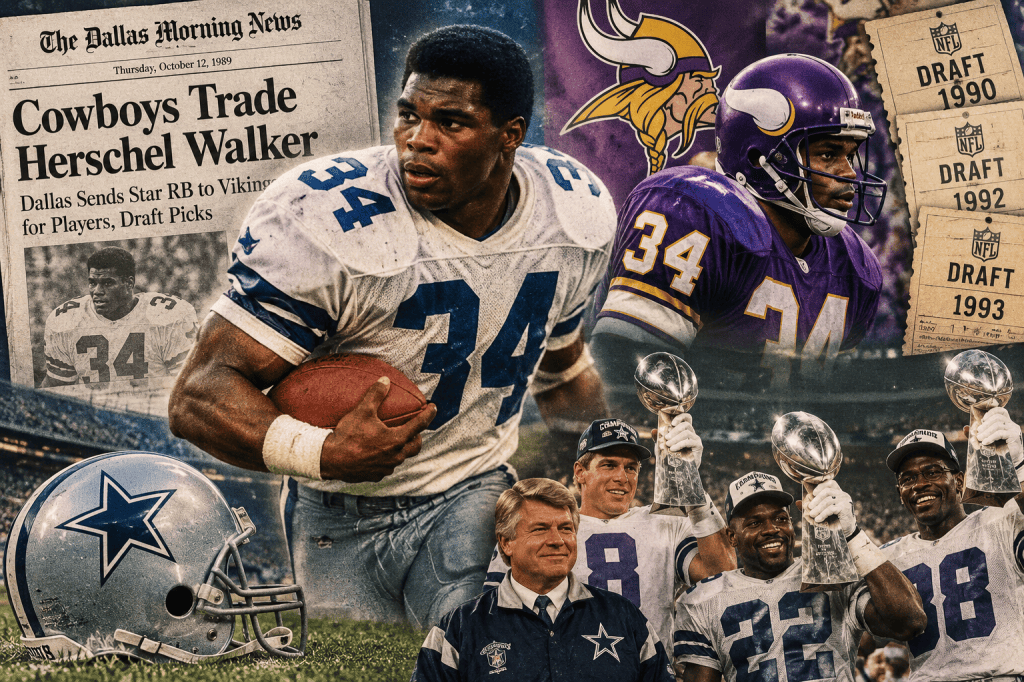
October 12, 1989: The day the Dallas Cowboys traded away their best player and somehow won three Super Bowls because of it.
Picture this. It’s October 1989.
George H.W. Bush is president. Batman has taken over movie theaters. Paula Abdul is all over the radio. And the Dallas Cowboys are absolutely terrible.
Not just bad. Historically bad.
But they have one thing going for them: Herschel Walker.
Walker is a legitimate superstar. A former Heisman Trophy winner, a tremendous athlete, and just about the only reason anyone would willingly sit through a Cowboys game that season.
So naturally, Dallas decides to trade him.
And not for another superstar.
For what essentially amounted to half the Minnesota Vikings’ future.
Minnesota Thought It Had Just Won the Lottery
The Vikings were convinced they were one player away from the Super Bowl. Walker was supposed to be that player.
Minnesota acquired Walker and draft picks from Dallas in exchange for five players and a complicated collection of draft picks and conditional selections.
At the time, the thinking seemed reasonable enough.
Minnesota was getting a proven star. Dallas was getting a bunch of names, draft choices, and hope.
The Vikings were thinking Super Bowl.
Jimmy Johnson was thinking something much bigger.
Jimmy Johnson Was Playing Chess
Here’s where the story gets fascinating.
The Cowboys weren’t particularly interested in keeping all those veteran players. Johnson and the Dallas front office had structured the deal so that cutting certain players would trigger additional draft-pick compensation.
And that’s exactly what happened.
Dallas turned the transaction into an extraordinary collection of draft capital.
Over the next several years, the Cowboys used those assets, along with additional trades, to help build the foundation of a dynasty.
Emmitt Smith. Darren Woodson. Russell Maryland. And a roster that would soon make the rest of the NFL miserable.
Not every one of those players came directly from Minnesota’s picks, but the Walker deal helped make the larger rebuilding machine possible.
Meanwhile, the Vikings had Herschel Walker.
A very good football player.
Just not a player who could single-handedly carry an entire franchise to the promised land.
The Results Were Almost Comical
By January 1993, the Cowboys were Super Bowl champions.
Then they won again.
And again.
Troy Aikman, Michael Irvin, and Emmitt Smith became household names. Jimmy Johnson became a coaching legend. Dallas became America’s Team all over again, whether the rest of America liked it or not.
Minnesota, meanwhile, never reached a Super Bowl with Walker. He lasted only two and a half seasons before moving on.
The Vikings had traded away a remarkable amount of their future for a player who never delivered what they’d hoped.
The Trade That Changed How the NFL Did Business
The Herschel Walker trade wasn’t simply a bad deal for Minnesota.
It became a cautionary tale.
The NFL learned that draft picks weren’t merely consolation prizes. In the right hands, they were currency capable of building a championship roster.
And sometimes, the smartest move a franchise can make is trading away its best player.
The Cowboys went 1–15 in 1989.
Four seasons later, they were celebrating their second consecutive Super Bowl championship.
All because Jimmy Johnson looked at his best player and saw something nobody else did.
Not a running back.
An entire football team.
Sports Americana: Where sports history still matters.


Leave a Reply