Imagine waking up on Monday, October 21, 1996.
You grab the morning newspaper, flip straight to the sports section, and check the NFL standings. Maybe you’re still talking about yesterday’s games. Maybe you’re already arguing with your buddies about which team is actually good.
There’s no RedZone. No social media. No 47 different camera angles of a controversial call. If you missed the game, you’d better hope the highlights come on NFL Primetime that evening.
And what a time it was to be an NFL fan.
The 1996 season was approaching its halfway point, and the league was giving us a little bit of everything: a legendary quarterback playing like a man possessed, a defending dynasty trying to reclaim its throne, two young expansion franchises making history, and enough unexpected contenders to make the playoff picture look like a spilled bowl of alphabet soup.
Let’s open the time capsule.
The Packers Were Starting to Look Terrifying
If you wanted to know which team had the look of a future champion, Green Bay was making a pretty convincing argument.
Brett Favre and the Packers entered the week at 6–1, fresh off a thrilling 23–20 overtime victory over the San Francisco 49ers on October 14.
Favre threw for 395 yards in that game. Wide receiver Don Beebe hauled in 220 receiving yards, and the Packers survived a heavyweight showdown between two NFC powerhouses.
Think about that for a moment.
The 49ers were still a major force, Steve Young was still one of the most dangerous quarterbacks in football, and Green Bay had just beaten them in a game that felt like a playoff preview (although Young missed this matchup with an injury).
Favre was playing with that familiar combination of brilliance, confidence, and the occasional suggestion that the laws of physics were merely optional.
And the Packers weren’t just winning. They were beginning to look like a team that could win it all.
Of course, hindsight tells us exactly how this story ended. Green Bay would finish 13–3, capture the NFC Championship, and defeat the New England Patriots in Super Bowl XXXI.
But on October 21, that Lombardi Trophy was still a dream.
For now, Packers fans had every reason to feel optimistic. And perhaps a few reasons to worry about Favre attempting a throw that made absolutely no sense.
That’s part of the fun.
America’s Team Was Still Hanging Around
Meanwhile, down in Dallas, the Cowboys were reminding everyone that they weren’t ready to surrender the spotlight.
Troy Aikman, Emmitt Smith, and Michael Irvin were still the faces of a franchise that had dominated the early part of the decade. The dynasty had won three Super Bowls in four seasons between 1992 and 1995.
But the 1996 Cowboys weren’t quite the unstoppable machine of their championship years.
They entered October 20 at 3–3 and desperately needed to keep pace in the NFC East.
Their opponent? The Atlanta Falcons, who arrived in Dallas still searching for their first victory of the season.
Atlanta made the Cowboys work for it. The Falcons scored 28 points and moved the ball effectively, but Dallas escaped with a 32–28 win. Emmitt Smith scored twice on the ground, Aikman threw for 265 yards and two touchdowns, and Michael Irvin caught seven passes for 119 yards.
It wasn’t exactly a defensive masterpiece.
But nobody in Dallas was handing out style points. They were handing out victories.
The win moved Dallas to 4–3, keeping the Cowboys in the conversation while the rest of the NFC East tried to figure out how to knock them off their perch.
The dynasty wasn’t quite dead. It just wasn’t looking quite as invincible.
Excuse Me, But Who Invited the Carolina Panthers?
Now here’s where the 1996 NFL season gets really interesting.
The Carolina Panthers were playing only their second season of existence, and they were already making the league’s established franchises nervous.
On October 20, Carolina defeated the New Orleans Saints 19–7, improving to 5–2.
Read that again.
A second-year expansion franchise was sitting at 5–2, right alongside some of the biggest names in football.
The Panthers had started their inaugural season in 1995 with a respectable 7–9 record. In 1996, they were taking another enormous step forward under head coach Dom Capers.
They had an aggressive defense, a developing identity, and absolutely no interest in waiting their turn.
Quarterback Kerry Collins was still developing, but Carolina had built a team capable of winning games with its defense and running game. The victory over New Orleans was another example of a young franchise figuring out how to compete.
And the Panthers weren’t the only newcomers making noise.
The Jacksonville Jaguars, another expansion team that debuted in 1995, had already shown flashes of promise. Jacksonville stood at 3–5 after a narrow 17–14 loss to the St. Louis Rams on October 20.
The Jaguars would eventually become one of the great surprises of the 1996 season, advancing all the way to the AFC Championship Game.
On October 21, nobody could have known just how far these two franchises would go.
But Carolina was looking like a legitimate playoff contender, and Jacksonville was showing signs of life.
Not bad for a couple of teams that had barely been around long enough to establish a proper rivalry.
The Denver Broncos Were Bringing the Firepower
Out west, the Denver Broncos were quietly putting together one of the NFL’s most impressive starts.
John Elway was still the veteran leader, but the offense was increasingly built around a young running back named Terrell Davis.
And Davis was becoming a problem for opposing defenses.
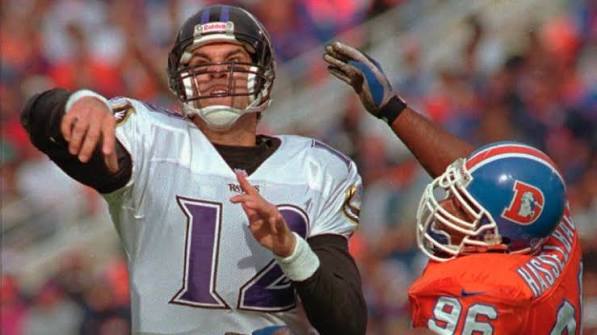
On October 20, Denver defeated the Baltimore Ravens 45–34 in an offensive shootout. Davis rushed for 194 yards, while tight end Shannon Sharpe caught passes for 161 yards.
Yes, 161 receiving yards from a tight end.
In an era when linebackers were expected to be able to cover somebody, Sharpe was making defensive coordinators reconsider their career choices.
The Broncos’ victory improved their record to 6–1, putting them among the league’s elite teams.
Davis was emerging as one of the NFL’s premier running backs, and Denver had the balance to punish opponents through the air or on the ground.
The Broncos would eventually finish 13–3, but the 1996 season would end in disappointment when they lost to the Jacksonville Jaguars in the playoffs.
For now, though, Denver looked like a legitimate Super Bowl threat.
Kansas City Wasn’t Going Anywhere, Either
And don’t forget the Kansas City Chiefs.
Marty Schottenheimer’s Chiefs had developed a reputation for being tough, disciplined, and exceptionally difficult to beat at Arrowhead Stadium.
They were 5–2 heading into the week and opened Week 8 by defeating the Seattle Seahawks 34–16 on October 17.
Kansas City had a defense that could frustrate opposing quarterbacks and a running game that could control the clock.
Quarterback Steve Bono was leading the offense, while veteran running back Marcus Allen remained a valuable weapon.
The Chiefs had won 13 games in 1995, and expectations remained high.
They weren’t always flashy, but they were the sort of team nobody wanted to see in January.
There was just one problem: Kansas City had to navigate an increasingly crowded AFC, with Denver, Pittsburgh, Houston, Buffalo, and Indianapolis all making their own claims to contention.
The race was wide open.
The Rest of the League Was Getting Interesting
The NFL landscape on October 21 was filled with compelling storylines.
The Washington Redskins were 6–1 and riding a six-game winning streak after beating the New York Giants 31–21. Washington was no longer just a team trying to rebuild its identity; it was becoming a serious NFC contender.
The Philadelphia Eagles were 5–2 after defeating Dan Marino and the Miami Dolphins 35–28. Running back Ricky Watters was a major factor, piling up 173 rushing yards in the victory.
The Houston Oilers were also 5–2 after defeating the Pittsburgh Steelers 23–13. Eddie George was becoming a centerpiece of the offense, and the Oilers were beginning to look like a team capable of making some noise.
And then there were the Buffalo Bills.
The Bills had moved to 5–2 after defeating the New York Jets 25–22 on October 20. Buffalo was still trying to establish itself in the post-Super Bowl era, but it remained a dangerous team with plenty of experience.
The Indianapolis Colts were also 5–2, even after losing to the New England Patriots 27–9.
In other words, there wasn’t a single dominant team in the AFC. There were several good ones, and the race was only going to get more complicated.
Monday Night Football: The Raiders and Chargers
Of course, October 21 wasn’t just about looking back at Sunday’s games.
There was still football to be played.
That evening, the Oakland Raiders traveled to San Diego to face the Chargers on Monday Night Football.
The Raiders entered the game at 4–3, while the Chargers were 4–3 as well. Both teams were trying to establish themselves in a competitive AFC West that already featured the 6–1 Broncos and 5–2 Chiefs.
It was the kind of matchup that could quietly become important later in the season.
And it was a reminder of what made the old divisional races so compelling. You weren’t just chasing a playoff spot. You were chasing the teams you saw twice every season, the teams whose fans you knew, and the teams you absolutely did not want to hear about at work on Tuesday morning.
The Raiders ultimately won 23–14, moving to 5–3 and handing San Diego another loss.
But before kickoff, it was one more piece of the puzzle in a season that was still taking shape.
The NFL Was Different Then
Looking back at October 21, 1996, the thing that stands out isn’t just the teams or the players.
It’s the atmosphere.
The NFL still felt like a collection of regional rivalries and personalities. The Cowboys were still America’s Team. The Packers were a blue-collar franchise becoming a powerhouse. The Chiefs were built around defense and discipline. The Broncos had Elway and a young running back who was about to become a superstar.
And two expansion franchises were trying to prove they belonged.
There were no smartphone alerts telling you every time a player sneezed. No endless arguments over quarterback rankings. No social media outrage cycle every time a coach punted on fourth-and-short.
You watched the games, checked the newspaper, listened to the radio, and argued with your friends.
And if you were lucky, you caught NFL Primetime on ESPN and watched Chris Berman break down the weekend with a highlight package that made every game feel like an event.
The NFL was still evolving, but the basic ingredients were already there: great quarterbacks, memorable rivalries, unexpected contenders, and enough unpredictability to keep fans coming back every Sunday.
The Takeaway: A Championship Season Was Taking Shape
On October 21, 1996, the Green Bay Packers and Denver Broncos were both 6–1. Washington was right there at 6–1, too. Carolina was sitting at 5–2, while the Chiefs, Eagles, Oilers, Colts, Bills, and 49ers were all in the thick of the race.
The Cowboys were still dangerous, even if they weren’t quite as dominant as they’d been earlier in the decade.
And the Panthers were showing that expansion teams didn’t have to spend years waiting for their moment.
The beauty of looking back is knowing what came next.
The Packers would win Super Bowl XXXI. The Patriots would emerge as the AFC champions. The Jaguars would shock the football world by reaching the AFC Championship Game. And the Panthers would finish their second season with a winning record and a playoff berth.
But on that Monday in October, none of it was guaranteed.
There were still two months of football left, injuries to survive, rivalries to settle, and playoff dreams to either build or bury.
And somewhere, a football fan was sitting at the kitchen table, reading the box scores, drinking a second cup of coffee, and convincing himself that this was finally his team’s year.
Thirty years later, some things never change.


Leave a Reply