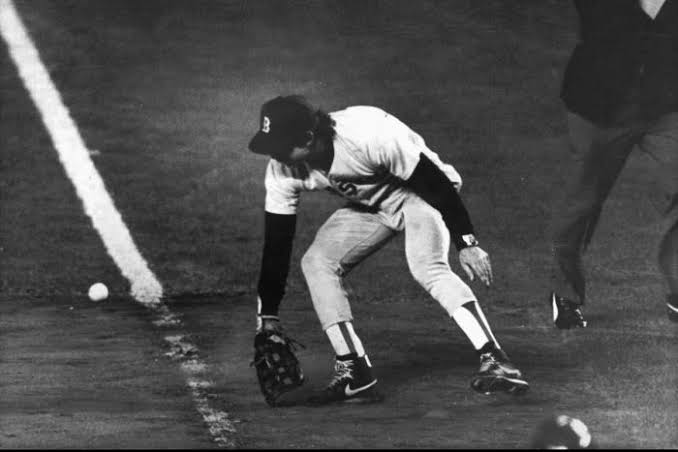
Before Bill Buckner became a baseball legend for all the wrong reasons, the Boston Red Sox were just one strike away from ending 68 years of heartbreak. Then came the tenth inning.
There are certain moments in sports that become so famous they swallow everything around them.
The helmet catch. The Music City Miracle. The shot that Jordan took over Bryon Russell.
And, of course, the ground ball that rolled through Bill Buckner’s legs.
Ask somebody about the 1986 World Series, and chances are they’ll tell you about Buckner. They’ll describe the ball rolling into right field, Ray Knight racing home, and the New York Mets erupting into a celebration that seemed to shake Shea Stadium.
But here’s the thing about baseball history: sometimes the most famous moment isn’t even the most unbelievable part of the story.
Because before Buckner’s error, before the ball rolled between his legs, and before an entire generation of Red Sox fans experienced a collective emotional collapse, Boston had practically won the World Series.
Practically.
And if you’ve followed sports long enough, you know that word can be downright dangerous.
A World Series 68 Years in the Making
The year was 1986.
Ronald Reagan was in the White House. Top Gun was taking over movie theaters. Everybody seemed to own a VCR, and the term “smartphone” would’ve been received with blank stares of confusion.
Meanwhile, the Boston Red Sox were chasing something that had eluded the franchise since 1918: a World Series championship.
The Red Sox had spent decades living beneath the shadow of the so-called Curse of the Bambino, the legend that followed the sale of Babe Ruth to the New York Yankees.
By 1986, Boston fans had become experts in heartbreak. They had seen close calls, painful finishes, and enough October disappointment to qualify for a graduate degree in suffering.
But this team was different.
Led by Wade Boggs, Jim Rice, Dwight Evans, Roger Clemens, and a roster that could compete with anybody, the Red Sox reached the World Series against the powerful New York Mets.
The Mets were brash, talented, and absolutely convinced they belonged on top. They had the swagger of a team that knew it was good and the clubhouse personality of a team that probably wasn’t going to invite its opponents over for Thanksgiving.
It was a terrific matchup.
And by Game 6, Boston was one victory away from baseball immortality.
The Mets Were Supposed to Be Finished
Boston entered Game 6 with a 3–2 series lead.
The Red Sox had already won Game 5 behind a complete-game performance from Bruce Hurst. Now they were at Shea Stadium in New York, just nine innings away from finally putting the championship drought to bed.
Roger Clemens was on the mound, and Boston had a 3–2 lead heading into the eighth inning.
Then the Mets started chipping away.
New York scored in the eighth to tie the game, and suddenly Boston’s comfortable path to a championship had become a much more stressful affair.
Still, the Red Sox kept fighting.
In the top of the tenth, Dave Henderson delivered another huge home run, and Boston added a second run to take a 5–3 lead.
Two runs.
Three outs.
One World Series championship.
Somewhere in the Boston clubhouse, champagne was waiting. The celebration was so close that NBC had prepared for the trophy presentation.
This was supposed to be the part where the music swelled, the players hugged, and generations of Red Sox fans finally exhaled.
Baseball, however, had other plans.
Two Outs. Nobody On. And Then Everything Fell Apart.
The bottom of the tenth began with Boston reliever Calvin Schiraldi trying to finish the job.
He got two outs.
The Red Sox were one out away from winning the World Series.
Then Gary Carter singled.
Kevin Mitchell singled.
Ray Knight singled, driving in Carter and cutting Boston’s lead to 5–4.
Suddenly, the tying run was on third base.
Bob Stanley replaced Schiraldi and faced Mookie Wilson. With Wilson at the plate, a wild pitch allowed Mitchell to score, tying the game at 5–5 and moving Knight to second.
Just like that, Boston’s two-run lead had disappeared.
And the Mets weren’t finished.
Wilson kept battling through the at-bat. Then he hit a slow ground ball toward first base.
Bill Buckner moved to field it.
The ball rolled through his legs and into right field.
Knight scored.
The Mets had won, 6–5.
Shea Stadium exploded. Players poured onto the field. The Red Sox stood stunned.
And somewhere in the span of a few minutes, a potential championship celebration had turned into one of the most painful endings in baseball history.
The Error That Became Bigger Than the Game
Here’s where the story gets unfair.
Buckner’s error became the defining image of the 1986 World Series. For years, it followed him everywhere. It appeared in highlight packages, sports documentaries, jokes, and conversations about the most devastating mistakes in sports.
But the game was already tied when the ball slipped past him.
Boston had surrendered three consecutive singles and then allowed the tying run to score on a wild pitch. The Red Sox had multiple opportunities to close out the inning before the final ground ball.
Buckner’s error was the final blow, not the entire collapse.
And that distinction matters.
Buckner was an accomplished major-league hitter and a valuable part of the Red Sox team that had made it to October. He was also playing through physical problems, and manager John McNamara chose to leave him in the game rather than make a late defensive substitution.
None of that changes what happened on the field.
But it does change the way we should remember it.
Sports fans love a villain. It’s easier to attach an entire defeat to one person than to accept that games are complicated, teams make mistakes, and sometimes an extraordinary series of events unfolds in the span of a single inning.
Buckner became the face of a team-wide collapse.
He deserved better than being reduced to one ground ball.
And then the Mets Had to Win One More Game
Here’s the part that sometimes gets lost in the retelling.
The Mets still had to win Game 7.
And they did.
New York beat Boston 8–5, completing the comeback and capturing the World Series championship. The Mets had survived a game that seemed lost, then finished the job the following night.
For Mets fans, 1986 became a glorious chapter in franchise history.
For Red Sox fans, it became another painful entry in a book that seemed to have no final page.
The Mets had their parade. Boston had its questions. And Bill Buckner had an unwanted place in baseball folklore.
The Red Sox wouldn’t win another World Series until 2004, when they finally ended the championship drought with a title run that included a historic comeback against the Yankees.
By then, the Buckner play had become a symbol of everything Boston fans feared October could do to them.
But history eventually offered a little perspective. Buckner returned to Fenway Park in 2008 to a warm reception from Red Sox fans, a reminder that the city could embrace a man who had endured decades of unfair criticism.
It was a welcome moment of grace.
The Sports Americana Verdict
The 1986 World Series wasn’t just about a ground ball slipping through a first baseman’s legs.
It was about how quickly certainty can turn into panic.
It was about a team that needed one more out and couldn’t find it.
It was about a stadium that went from nervous anticipation to absolute delirium, and a clubhouse celebration that never happened.
Most of all, it was about the strange way sports history works.
One play becomes the headline. The other 99 percent of the story gets pushed into the background.
So the next time somebody brings up Bill Buckner, remember the whole inning. Remember the singles, the wild pitch, the two-out rally, and the Mets refusing to go quietly.
Remember that Boston had a two-run lead in the tenth and was one out away from a championship.
And remember that baseball, more than almost any other sport, has a special talent for making a sure thing look ridiculous.
The Mets won the game. The Mets won the Series. And a slow ground ball became one of the most famous plays in sports history.
In the end, the 1986 World Series gave us a reminder that still holds up today:
In sports, you’re never really safe until the final out is recorded.
And sometimes, even then, you might want to check the replay.
That’s Sports Americana. Where the memories are timeless, the stories are bigger than the box score, and the past is always worth another look.


Leave a Reply