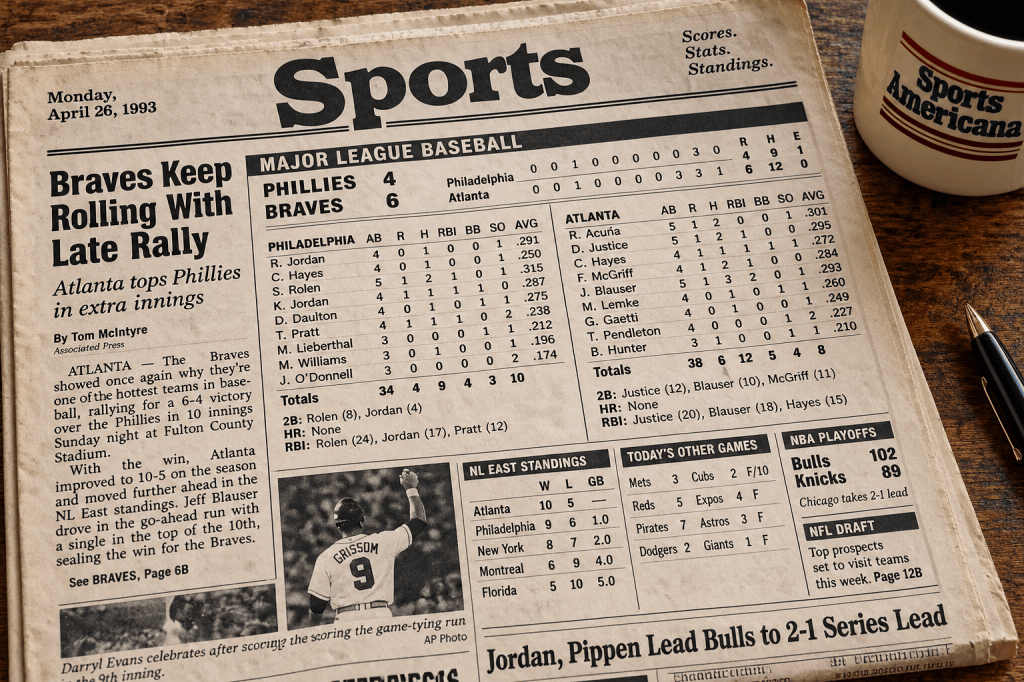
There was a time when finding out what happened in sports required actual effort.
Not much effort, mind you. We weren’t crossing the Oregon Trail or hunting for our own food. But if you wanted to know how your favorite team did last night, you had to wait for the newspaper.
And if you wanted to know how your favorite player did?
Well, you’d better know how to read a box score.
Welcome to the days before the internet, when the sports section was our personal ESPN, Google, StatMuse, and occasionally the source of a completely irrational argument with our friends.
The Morning Ritual
Picture a weekday morning in the 1990s.
The newspaper lands on the driveway. Somebody brings it inside. Coffee gets poured. Breakfast is served. And somewhere in the middle of all this, a kid who probably has absolutely no interest in world affairs makes a beeline for the sports section.
Forget the front page. Forget the weather.
Did the Braves win?
If you were a baseball fan, this was serious business.
You’d flip past the headlines and find the box scores, those beautiful little grids of numbers that told you everything you needed to know.
Hits. Runs. Errors. Home runs. Pitching decisions. Batting averages.
There was no slick animation. No notification telling you that your favorite player had just gone 3-for-4. No personalized feed. Just tiny print, columns of numbers, and the satisfaction of figuring it all out yourself.
And somehow, that was enough.
Actually, it was more than enough.
The Box Score Was a Treasure Map
For a young sports fan, the newspaper box score wasn’t just a record of a game. It was an invitation to explore.
You could find out that a player you’d never heard of had hit two home runs. You could discover that your favorite pitcher had struck out 11. You could check the standings and calculate exactly how many games your team needed to make up.
You might even spend 20 minutes studying statistics for a game you hadn’t watched and couldn’t possibly have seen highlights of yet.
This was sports research before sports research became a profession.
And there was something wonderfully mysterious about it.
You didn’t immediately see every highlight. You didn’t have a thousand people online explaining what the result meant. You had a handful of numbers and your imagination.
If your team won 8–7, you could practically picture the ninth-inning chaos. If your ace gave up six runs, you could spend the entire morning wondering what went wrong.
Sometimes the mystery lasted until school let out.
Can you imagine?
Waiting hours to find out what happened in a sporting event?
Today’s sports fans would file a class-action lawsuit.
When the Sports Page Was the Whole World
Here’s the part that gets lost when we talk about nostalgia.
It wasn’t just that newspapers were different. It was that sports information moved at a different speed.
Today, every game is a live feed. Every rumor becomes breaking news. Every play gets clipped, posted, debated, and dissected before the players have even left the field.
Back then, information arrived in batches.
The newspaper came in the morning. SportsCenter came later. The local news had its highlights. And if you missed the game, you might have to settle for somebody’s description of what happened.
You learned to wait.
You learned to make the most of what you had.
And you learned that a sports story could live in your imagination long after the final score was printed.
There was a rhythm to it all. Yesterday’s game in the morning paper. Today’s game on television. Tomorrow’s conversation with your friends.
Sports didn’t stop happening between broadcasts, of course. We just weren’t connected to every second of it.
Maybe that was part of the magic.
The Final Score
Nobody is suggesting we should return to a world without instant scores, video highlights, or the ability to watch a game on a phone while standing in line at the grocery store.
Well, maybe somebody is. That person probably also owns a VCR that still flashes 12:00.
But there’s something worth remembering about those old newspaper sports sections.
They made us participants in the process of following sports. We searched for information. We studied numbers. We formed opinions. We argued with our friends. We learned players’ statistics without an app reminding us to check them.
We didn’t need the entire sports universe delivered to our fingertips.
We had a folded newspaper, a few minutes before school, and a box score that might as well have been the morning’s most important document.
And for a kid growing up in America, that was a pretty wonderful way to start the day.


Leave a Reply