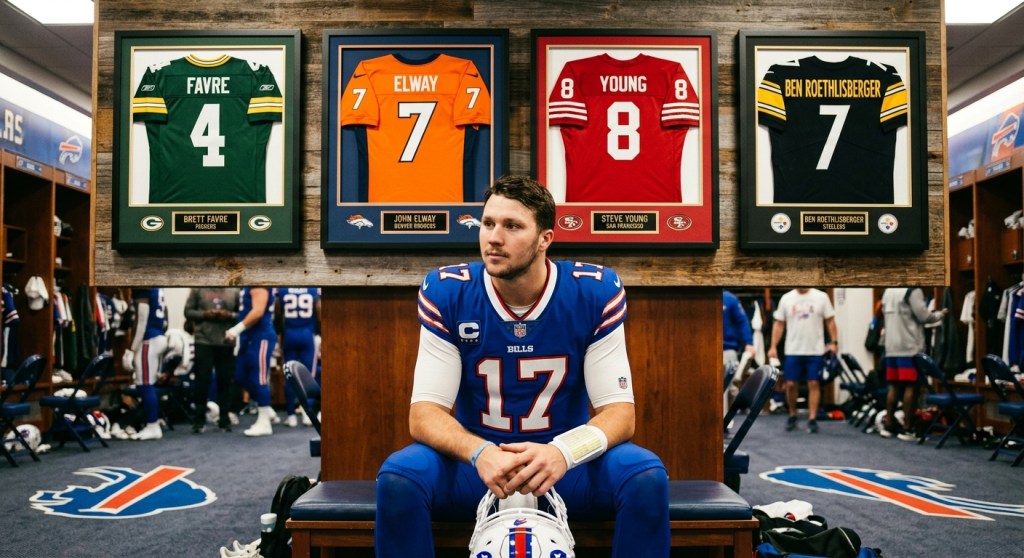
Josh Allen, the Buffalo Bills superstar, feels like a quarterback built from pieces of football history. He’s got the cannon arm of a Brett Favre, the improvisational magic of a John Elway, and the physical presence of a young Ben Roethlisberger. Add in the running ability that makes defensive coordinators lose sleep, and you’ve got something that doesn’t fit neatly into any historical comparison.
Allen isn’t a carbon copy of any one legend. He’s a little bit of several of them.
The Brett Favre comparison: Playing football like the rules are optional
Favre made a career out of believing every throw was possible. Sometimes that belief produced a legendary touchdown. Sometimes it produced an interception that made a coach reconsider his career choices.
Allen has that same gunslinger mentality. He can make throws that seem physically impossible, turning a collapsing pocket into a highlight before the defense has even finished celebrating its pass rush. Both are known for trademark toughness as well.
The difference? Allen brings a running dimension that Favre never quite possessed at the same level.
The John Elway comparison: The comeback artist
Elway was the quarterback you feared when a game was still close in the fourth quarter. He had the arm, the mobility, and the knack for making something out of absolutely nothing.
Allen carries that same larger-than-life presence. When Buffalo needs a play, he can beat a defense with his arm, escape pressure, or simply decide that the first-down marker belongs to him.
Like Elway, Allen often looks most dangerous when the play breaks down and the defense thinks it finally has him cornered.
The Steve Young comparison: The quarterback who can hurt you twice
Young was more than a great passer. He could dissect a defense from the pocket and then make it pay when it forgot he could run.
Allen takes that dual-threat formula to another level in terms of sheer power. Young could glide away from defenders; Allen can make a defender wonder whether tackling him was worth the trouble.
And the numbers back up the historical significance. Allen has established himself as one of the NFL’s most prolific rushing quarterbacks, setting the standard for rushing touchdowns by a quarterback. His combination of passing production and goal-line power is a rare historical blend.
The Ben Roethlisberger comparison: Good luck bringing him down
Remember young Big Ben? Defenders would get their hands on him, the pocket would collapse, and somehow he’d remain upright long enough to find a receiver downfield.
Allen has that same combination of size, strength, and stubborn refusal to let a play die. He isn’t merely escaping pressure. Sometimes he’s absorbing it, bouncing off contact, and making the defense pay for thinking the play was over.
The modern twist: Allen is his own category
Here’s where the comparisons fall short.
Favre had the arm. Elway had the comeback magic. Young had the mobility. Roethlisberger had the power.
Allen combines elements of all four while playing in an era that demands quarterbacks be both precision passers and legitimate running threats.
He’s also a reminder that the evolution of the position doesn’t always mean leaving the past behind. Sometimes it means taking the best parts of several generations and putting them into one player.
Of course, history still has one question for Allen: Can he lead Buffalo to the ultimate prize? The greatest quarterbacks aren’t remembered solely for their physical gifts or statistical achievements. They’re remembered for the championships, the signature moments, and the games that become part of football folklore.
Until then, the comparisons will continue.
And maybe that’s the fun of watching Josh Allen.
He can make you think of Favre, Elway, Young, and Roethlisberger in the span of a single drive. He can remind you of the football you grew up watching while giving you something that feels entirely new.
Josh Allen isn’t the next version of an old legend. He’s building a legacy that future generations will use as their comparison.
And in the grand history of the NFL, that’s a pretty good place to start.


Leave a Reply