Football was dying.
Not because people didn’t love it.
Because they loved it too much.
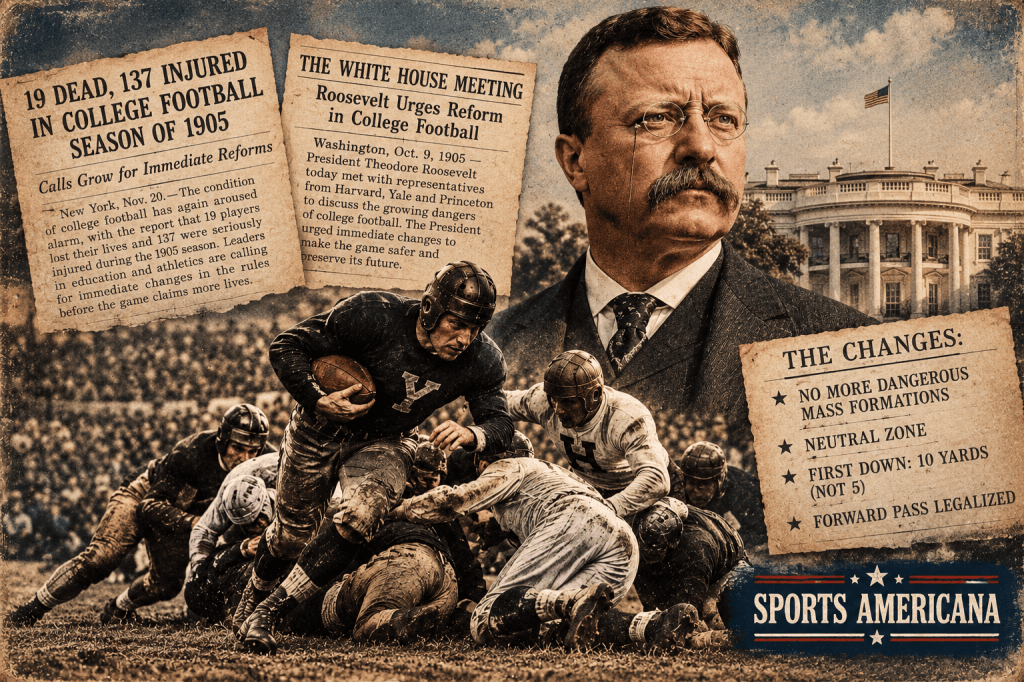
By 1905, college football had become a brutal spectacle. Players were getting seriously injured—and sometimes killed—in mass formations where a pile of bodies could move several yards without anyone outside the pile knowing exactly what was happening.
That year alone, 19 players died and 137 suffered serious injuries.
Even President Theodore Roosevelt had seen enough.
And Roosevelt was hardly a football critic. He loved the game. His son, Theodore Roosevelt Jr., was playing football at Harvard.
But the president understood that if football didn’t change, it might not survive.
So on October 9, 1905, Roosevelt invited representatives from Harvard, Yale and Princeton to the White House.
His message was simple:
Clean up the game. Or lose it.
The result was one of the biggest transformations in sports history.
Rules were changed. Dangerous formations were restricted. The first-down requirement went from five yards to ten.
And then came the biggest change of all:
The forward pass was legalized.
The game that had once been a brutal exercise in pushing, pulling and smashing suddenly had room to become something else.
A game of strategy.
A game of speed.
A game that looked a little more like the football we know today.
Roosevelt didn’t invent the forward pass. He didn’t create the NCAA.
But when college football was in danger of disappearing, the President of the United States decided it was worth saving.
And sometimes, the history of sports turns on the strangest moments.
Like the day a football problem ended up in the White House.
Sports Americana.
Because sometimes the history of the game is bigger than the game itself.


Leave a comment