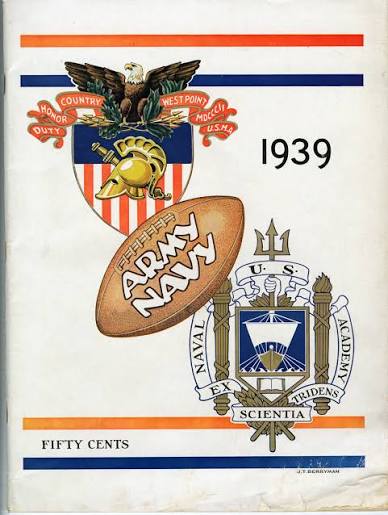
There was a time when the most intimidating teams in college football weren’t Alabama, Michigan, Ohio State, Georgia or Notre Dame.
They wore Army gray.
Or Navy blue.
And beating them wasn’t just difficult.
It was a national event.
Today, Army, Navy and Air Force occupy a unique corner of college football. They have passionate fan bases, proud traditions and one of the sport’s greatest rivalries.
But for a stretch in the middle of the 20th century, the service academies weren’t simply part of college football.
They were college football royalty.
Army Was a Juggernaut
The peak came during World War II.
Army entered the 1940s as a respected program, but by 1944, the Black Knights had become virtually unstoppable.
The 1944 Army team went 9–0, finishing the season ranked No. 1 and outscoring its opponents 504–35.
That’s not a typo.
Five hundred and four points.
Thirty-five allowed.
And Army wasn’t beating up on a schedule full of cupcakes. The Black Knights demolished Notre Dame 59–0 and crushed Navy 23–7.
The following year was somehow just as ridiculous.
Army went 9–0 again, finishing No. 1.
And sitting right behind them?
Navy.
For one glorious moment, the service academies owned the top two spots in college football.
Enter Mr. Inside and Mr. Outside
If you’re looking for the faces of Army’s golden age, start with two names:
Doc Blanchard.
Glenn Davis.
Blanchard was “Mr. Inside.”
Davis was “Mr. Outside.”
Together, they formed one of the most famous backfields in college football history.
Blanchard won the Heisman Trophy in 1945.
Davis won it in 1946.
And Army won three consecutive national championships from 1944 through 1946.
Imagine that today.
A service academy winning three straight national titles.
It sounds almost impossible.
Back then, it was reality.
Navy Wasn’t Exactly Taking Notes From the Sidelines
The story isn’t simply about Army dominating everybody.
Navy was right there.
The Midshipmen finished the 1945 season 8–0–1, ranked No. 2 nationally.
And that tie?
Against Notre Dame.
The Army-Navy rivalry had become a meeting between two legitimate national powers.
This wasn’t merely about bragging rights between future officers.
The game could determine the national championship picture.
That’s what makes the history so fascinating.
Today, the Army-Navy Game is one of the great traditions in American sports.
Back then, it could be the biggest game of the college football season.
Football and the War
Of course, there was a reason the academies became such extraordinary football powers during this era.
The country was at war.
The military academies were producing future officers, and their football teams were filled with young men who were preparing for military service.
Football itself also became intertwined with the national mood.
The games were enormous patriotic events.
The players weren’t simply college athletes. Many would soon be heading into military service.
And some would never return.
That gave the games—and especially the Army-Navy rivalry—a weight that is difficult to replicate today.
Then College Football Changed
Eventually, the sport moved on.
College football became increasingly specialized.
Recruiting became more sophisticated.
Scholarship opportunities expanded.
Television transformed the economics of the sport.
Major conferences grew into massive athletic enterprises.
And the service academies faced an obvious limitation:
Their players had to meet military requirements first.
An Army football player wasn’t simply choosing between Army and another college.
He was choosing a military career.
That made recruiting and roster construction fundamentally different.
The rest of college football kept getting bigger.
The academies couldn’t simply follow it down the same road.
The Fall From the Top
Army and Navy never stopped mattering.
They never stopped producing great players.
And they certainly never stopped producing memorable moments.
But the days of routinely competing for national championships disappeared.
Army’s last major national championship came in 1946.
Navy came closest to returning to the very top during the 1950s and early 1960s, including Roger Staubach’s unforgettable 1963 season.
Air Force eventually joined the conversation as the third major service academy program, producing nationally ranked teams and multiple conference championships.
But the era when the academies could sit atop the entire college football world was gone.
And perhaps that’s what makes that era so fascinating.
Imagine It Today
Imagine turning on college football this Saturday and seeing:
No. 1 Army vs. No. 2 Navy.
The winner potentially playing for the national championship.
Heisman Trophy candidates lining up in the backfield.
The entire country watching.
That’s what college football looked like once upon a time.
Before the super conferences.
Before the transfer portal.
Before NIL.
Before 12-team playoff brackets.
Before college football became the enormous machine it is today.
There was a time when the nation’s most powerful football programs were also its military academies.
Army. Navy.
They weren’t merely playing football.
They were dominating it.
And for a few remarkable years in the 1940s, the road to the top of college football ran straight through West Point and Annapolis.
Now that’s a piece of college football history worth remembering.


Leave a comment