There was a time when you could watch an entire NFL Sunday without having a second television, three streaming services, or your phone blowing up with notifications.
You just needed ESPN.
And around 7:30 on Sunday night, you knew exactly what was coming.
“He. Could. Go. All. The. Way!”
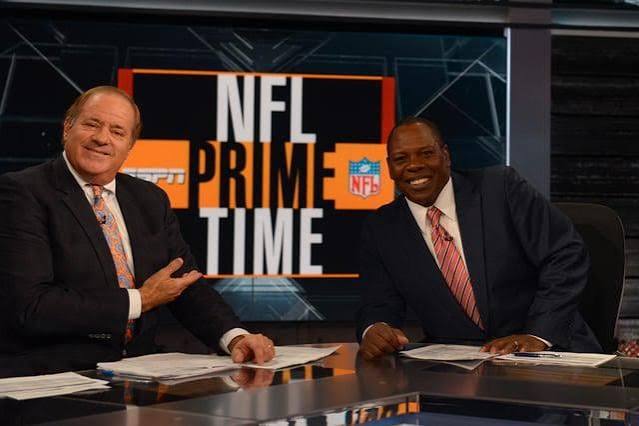
Welcome to NFL PrimeTime.
From 1987 through 2005, Chris Berman and Tom Jackson turned Sunday night into an unofficial holiday for football fans.
The concept sounds almost quaint now: Take every Sunday afternoon NFL game, show the important parts, add some music, let Berman go completely off the rails with nicknames and sound effects, let T.J. explain what actually happened—and somehow cram the entire NFL into an hour.
But it worked.
It really, really worked.
The Perfect Time
NFL PrimeTime debuted on September 13, 1987, the same year ESPN began carrying NFL games. The original crew featured Berman, Jackson and Pete Axthelm.
It was essentially television’s answer to a question every football fan had:
“What the hell happened today?”
And in the pre-internet NFL, that was a legitimate question.
Maybe you watched your favorite team.
Maybe you caught the Cowboys game.
Maybe your local station showed the Bears.
But there were 13 or 14 other games happening around the league.
PrimeTime brought them all to you.
And it didn’t simply flash the score on the screen and move on.
The show used extended highlights to actually tell the story of the game—sometimes showing the seemingly mundane plays that explained how a team won or lost.
That was part of the magic.
You didn’t just find out that the Vikings beat the Packers.
You watched how they did it.
Then There Was Boomer
Chris Berman wasn’t merely the host.
He was the soundtrack.
He could turn a routine 18-yard run into a Hollywood production.
A running back wasn’t simply running through a hole.
He was “rumblin’, bumblin’, stumblin’!”
A receiver wasn’t simply catching a touchdown.
He was going “all the way!”
And then there were the nicknames.
Curtis “My Favorite” Martin.
Jake “The Snake” Plummer.
“Da Raiders.”
The endless player-name puns.
The exaggerated touchdown calls.
The famous sound effects.
Berman understood something that television executives sometimes forget:
Sports are supposed to be fun.
He didn’t treat every highlight like a serious news report.
He turned it into entertainment.
And T.J. Was the Perfect Counterweight
If Berman was the carnival, Tom Jackson was the football coach standing next to it explaining what was happening.
Jackson joined ESPN in 1987 after a 14-year NFL career with the Denver Broncos.
His job wasn’t to compete with Berman.
It was to balance him.
Berman could spend 30 seconds making a joke about a quarterback.
Jackson could spend the next 30 seconds explaining exactly why that quarterback succeeded.
That chemistry became one of the great television partnerships in sports.
They weren’t simply host and analyst.
They were friends who happened to have an NFL highlight reel sitting in front of them.
And you could tell.
The Music
Then there was the music.
Oh, the music.
Those dramatic instrumental tracks underneath the highlights made a Sunday afternoon game between two 6-6 teams feel like the fate of civilization was hanging in the balance.
A fourth-quarter interception?
Epic.
A running back breaking a 35-yard touchdown?
Epic.
A quarterback kneeling out the final 40 seconds?
Somehow…
Still epic.
The music became part of the identity of the show.
You could hear the opening notes and immediately know:
Football Sunday wasn’t over yet.
The Show Before the Show
The genius of PrimeTime was its place in the Sunday ritual.
The afternoon games ended.
Dinner happened.
Maybe you checked the newspaper box scores.
Maybe you called your buddy.
And then you sat down for PrimeTime.
For an hour, the entire NFL season passed in front of you.
The good.
The bad.
The ridiculous.
The unbelievable.
And the games you didn’t even know you had missed.
There was no RedZone.
No NFL Sunday Ticket for everyone.
No YouTube highlights five minutes after the game.
No Twitter telling you what happened before you even knew the game was being played.
If you wanted the NFL’s Sunday story, NFL PrimeTime was the place to be.
And Then It Disappeared
After the 2005 season, the original run came to an end.
ESPN acquired Monday Night Football, while NBC took over Sunday Night Football. PrimeTime was no longer part of the Sunday-night NFL landscape.
And something changed.
The NFL didn’t become less popular.
Television didn’t become less sophisticated.
The technology became dramatically better.
But something about Sunday night football became less intimate.
In 2019, ESPN brought Berman and Jackson back together for a new version of NFL PrimeTime on ESPN+, proving that the concept still had an audience.
But the original version belonged to a different television era.
An era when you actually had to wait for the highlights.
An era when the entire NFL could be packaged into one hour.
An era when Chris Berman could make a 23-yard gain sound like the greatest athletic achievement in human history.
And maybe that’s why people still remember it so fondly.
Because NFL PrimeTime wasn’t just about football.
It was about how we watched football.
For an entire generation of fans, Sunday wasn’t really over until Boomer told us what happened.
And then, finally, we could go to bed.
“He. Could. Go. All. The. Way!”
 Sports Americana
Leave a comment