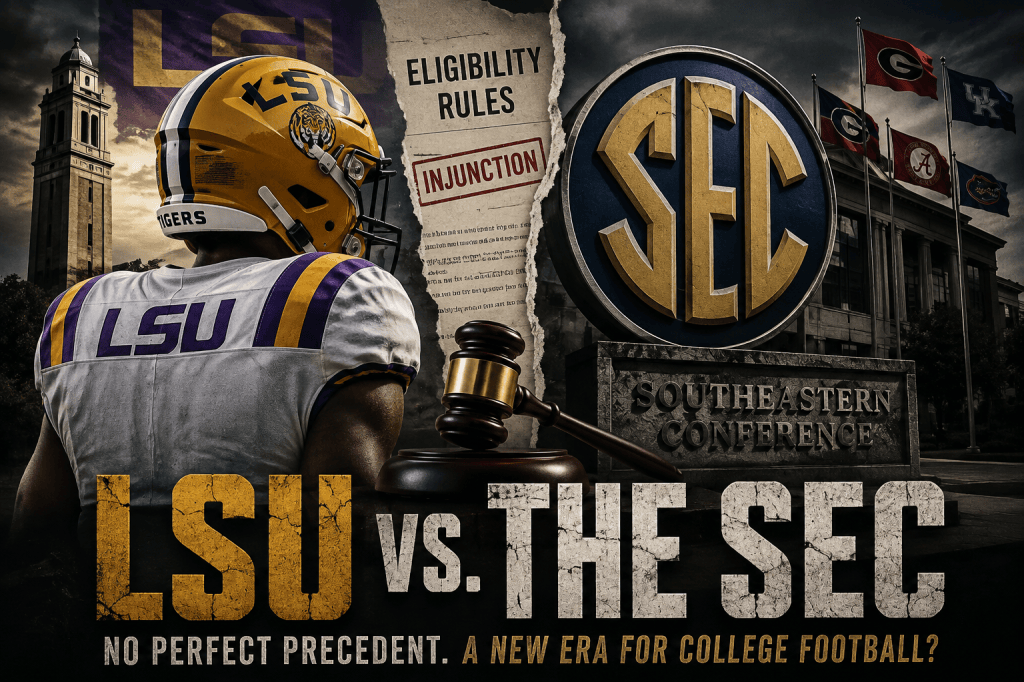
The Tigers’ eligibility fight may have a few historical cousins—but there is no perfect precedent for what is happening in Baton Rouge.
College football has always had its share of rules disputes.
Schools have fought conferences. Coaches have challenged administrators. Players have been declared ineligible. Conferences have punished members. And the NCAA has spent more than a century trying to draw a line between college athletics and professional sports.
But LSU vs. the Southeastern Conference feels different.
With the Tigers attempting to bring former NFL players back to college football, the SEC threatening significant penalties and now taking LSU to federal court, college football has entered territory that feels almost impossible to compare with anything from the past.
So, is there a precedent?
Sort of.
But perhaps the more important answer is: not really.
The Issue in Baton Rouge
The controversy centers on a group of athletes who received another season of college eligibility following a series of court challenges involving the NCAA’s evolving eligibility rules.
Two former Ole Miss players who briefly entered the NFL—Dae’Quan Wright and Zxavian Harris—became particularly important to the story after following Lane Kiffin to LSU.
The SEC responded by adopting a rule prohibiting member schools from using athletes with certain professional football backgrounds. The conference subsequently approved significant potential penalties for schools that violated the rule.
Then the legal gloves came off.
The SEC filed a federal lawsuit against LSU, arguing that the Tigers’ actions violate the conference’s rules and interfere with the SEC’s ability to govern itself.
And on Thursday, a Louisiana judge issued a preliminary injunction allowing the former professionals to join LSU’s roster while the larger eligibility dispute continues. The order also prevents the SEC from punishing LSU over the athletes covered by the case.
That’s where the history lesson gets interesting.
The SEC Has Never Expelled a Member
If some of the recent talk about potentially removing LSU from the conference sounds unprecedented, that’s because it essentially is.
The SEC has experienced plenty of disagreements with its members over the decades. But it has never expelled a school.
In fact, the conference’s history contains several examples of schools leaving because they could no longer agree with the direction of the league.
Sewanee left in 1940 as the SEC moved deeper into the era of athletic scholarships.
Georgia Tech departed in 1964 after legendary coach Bobby Dodd became increasingly frustrated with conference scholarship and recruiting policies.
Tulane followed in 1966 as the university continued to de-emphasize athletics.
None of those schools were kicked out.
They walked away.
That distinction could become enormously important if the LSU dispute eventually reaches the question of conference membership.
And LSU Isn’t Exactly Sewanee
That’s another reason this situation is so unusual.
LSU isn’t a peripheral member struggling to find its place in the SEC.
It’s one of the conference’s flagship football programs.
The Tigers have won national championships, produced generations of NFL players and become one of the most recognizable brands in college football.
Removing LSU from the SEC wouldn’t simply be another conference realignment story.
It would be a declaration that one of the most powerful programs in the sport had become incompatible with the rules of its own league.
That would be historic.
The Closest Conference Precedent? Look to the Big East
There is one particularly interesting modern example when it comes to a conference actually removing a member.
In 2004, the Big East expelled Temple.
But the circumstances were dramatically different.
Temple’s problems centered largely around football performance, attendance and the school’s ability to meet the conference’s competitive expectations—not a fundamental disagreement over whether conference rules governing athlete eligibility were legitimate.
The Big East situation therefore provides a precedent for conference expulsion, but not for the kind of philosophical and legal confrontation now developing between LSU and the SEC.
In other words:
Temple shows that a major conference can remove a member.
It doesn’t show us what happens when a conference and one of its most powerful members fundamentally disagree over who has the authority to determine whether a player can compete.
There Is Another Precedent—But It’s the NCAA
If we’re looking specifically at college football’s history of eligibility battles, the better comparison may actually be the NCAA itself.
For decades, the NCAA—not individual conferences—was the primary governing body determining whether athletes were eligible to compete.
Schools that used ineligible players could face sanctions, including forfeitures and postseason restrictions.
The problem for the NCAA today is that its authority has increasingly been challenged in court.
The current LSU situation grew out of a much larger eligibility fight involving athletes seeking an additional season under the NCAA’s changing eligibility framework. More than 40 athletes have been involved in litigation connected to the issue, while similar disputes have appeared around the country.
That creates an extraordinary situation.
For perhaps the first time on this scale, the courts are directly affecting the eligibility decisions that conferences and the NCAA traditionally made themselves.
And LSU is taking advantage of that opening.
The Bobby Dodd Connection
There’s another piece of SEC history worth remembering.
When Bobby Dodd led Georgia Tech out of the SEC in 1964, his dispute wasn’t about eligibility in the modern sense. It was about the fundamental rules under which SEC programs were expected to operate.
Dodd believed the conference’s scholarship system was unfair to athletes and schools.
The SEC disagreed.
Georgia Tech eventually decided that the disagreement was so fundamental that leaving the conference was preferable to continuing under the existing rules.
That’s an important historical reminder.
Conference membership has never meant that every member agrees with every rule.
But LSU is taking that concept to another level.
The Tigers aren’t simply threatening to leave.
They’re effectively saying:
We believe the rule itself cannot prevent these players from competing.
And now a court has temporarily agreed with them.
Why This Could Be the Real Precedent
That’s what makes LSU vs. the SEC so fascinating.
The ultimate precedent may not be whether LSU wins or loses.
It may be what happens afterward.
If LSU successfully uses a court order to place former professional athletes on its roster, what stops another SEC school from doing the same?
If the SEC can punish LSU despite a court order, what does that say about the authority of the conference?
If LSU can ignore a conference rule because a court says the athletes are eligible, does that effectively make conference eligibility rules unenforceable?
And perhaps the biggest question:
Who actually governs college football anymore?
The NCAA?
The conferences?
The individual universities?
The courts?
Or, increasingly, whoever can afford the best lawyers?
That is the question lurking behind this entire saga.
The Verdict: There Is No Real Precedent
College football has seen conference members leave.
It has seen schools expelled.
It has seen eligibility scandals.
It has seen battles over amateurism.
It has seen the NCAA impose some of the harshest penalties in American sports history.
But it has never quite seen this.
A flagship program is openly challenging its conference’s eligibility rule.
The conference is threatening unprecedented punishment.
The NCAA is simultaneously fighting its own battles over eligibility.
And a judge has stepped directly into the middle of it all.
The SEC’s own history makes the situation even more remarkable: the conference has never expelled a member, meaning removing LSU would create a precedent of its own.
Maybe that’s ultimately the story here.
LSU isn’t following an old college football precedent.
It may be creating the next one.
And decades from now, when someone looks back at the great turning points in the history of college football, the 2026 LSU-SEC battle may be remembered as the moment the traditional boundaries between college eligibility, conference authority and professional sports finally collapsed completely.
For a sport built on tradition, there may be no more appropriate—or more chaotic—way to enter a new era.


Leave a Reply