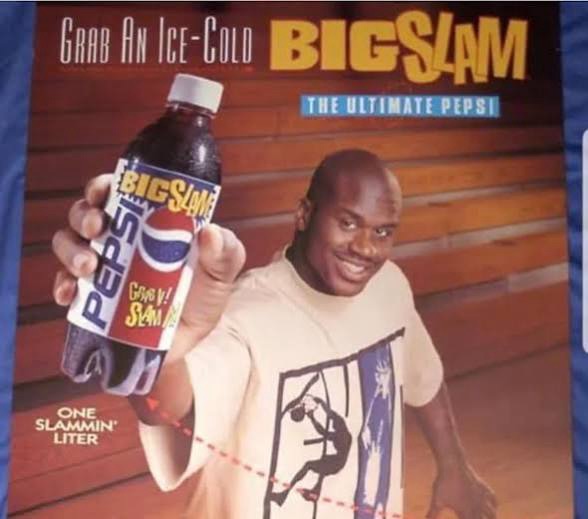
There was a time in America when bigger wasn’t just better.
Bigger was cooler.
And in the 1990s, few things represented that attitude quite like Pepsi and Mountain Dew’s Big Slam.
The one-liter bottle was essentially a piece of ’90s sporting culture disguised as a soft drink. Pepsi introduced the Big Slam in the early 1990s, and before long, the oversized bottle was being pushed through the same pop-culture machine that made professional athletes into household names.
And nobody embodied the idea of the Big Slam quite like Shaquille O’Neal.
Shaq + Pepsi = Peak ’90s
Shaq was only beginning his NBA career when Pepsi paired him with the Big Slam, but the combination made perfect sense.
He was enormous.
The bottle was enormous.
The entire campaign was enormous.
Pepsi’s famous Big Slam commercial played off Shaq’s size and personality, turning the 7-foot-1 basketball superstar into the perfect spokesman for a product built around the idea of more. The campaign became one of the memorable pieces of sports advertising from the decade.
In fact, decades later, Pepsi itself would look back at the 1994 Big Slam campaign when it reunited with Shaq for a new commercial. The company called the original spot a key inspiration for the 2023 campaign.
That’s some serious staying power for a one-liter bottle.
But It Wasn’t Just Pepsi
The Big Slam wasn’t exclusively a Pepsi phenomenon.
Mountain Dew was in the game, too.
By the middle of the decade, Big Slam bottles were being used across PepsiCo’s beverage lineup, including Pepsi, Diet Pepsi and Mountain Dew. A 1995 promotion even put special game pieces and winning codes on 300 million one-liter Big Slam and 20-ounce Quick Slam bottles across PepsiCo brands.
Mountain Dew was particularly well suited for the sports-obsessed ’90s.
The brand had already established itself as the drink of action sports, basketball, skateboarding, snowboarding and the growing extreme-sports culture. A Mountain Dew Big Slam practically looked like it belonged next to a basketball, skateboard or pair of rollerblades.
And the marketing didn’t stop with television commercials.
In 1995, Philadelphia 76ers rookie Jerry Stackhouse signed an endorsement deal with Mountain Dew that included advertising, promotions and a “Big Slam Twist and Win Game.”
That tells you everything about the era.
Athletes weren’t simply selling products.
The products were becoming part of the sports culture.
The ’90s Were Different
Today, a one-liter bottle of soda doesn’t exactly scream athletic lifestyle.
But in the 1990s?
It somehow did.
Sports marketing was bigger, louder and less subtle. Shaq. Michael Jordan. Charles Barkley. Ken Griffey Jr. Jerry Stackhouse. Extreme sports. NBA Jam. Starter jackets. Video games. Trading cards.
Everything seemed to be connected.
The Big Slam fit perfectly into that world.
It was oversized, colorful and unapologetically ’90s. It represented a time when sports stars weren’t just athletes — they were pop-culture icons.
And maybe that’s why people still remember those bottles.
Not because they were the greatest soda containers ever created.
But because they remind us of what sports felt like back then.
Before social media.
Before athletes had their own media networks.
Before every commercial could be targeted to you personally.
You saw Shaq on television, grabbed a Big Slam from the convenience store, and for a moment, the entire thing felt connected.
Basketball. Music. Soda. Advertising. Sports culture.
All in one giant bottle.
That was the Big Slam.
And that was the ’90s.
 Sports Americana
Leave a comment